|
|
 |
Uzbekistan |
|
The
journey to Uzbekistan was a French package tour. It was part of a
programme of visits of Central Asian countries to discover the Turco-Moslem
world in Asia.
The group was composed of 14 people. A French guide,
a specialist in Central Asia, accompanied us.
The
tour was made in 1996, from April 29 to May 11. After a Lufthansa
flight, we arrived in Tashkent was on time.
The report is in five tables. The general comments are given by the
Uzbekistan presentation. |
|
|
|
|
Tashkent |
|
|
|
|
|
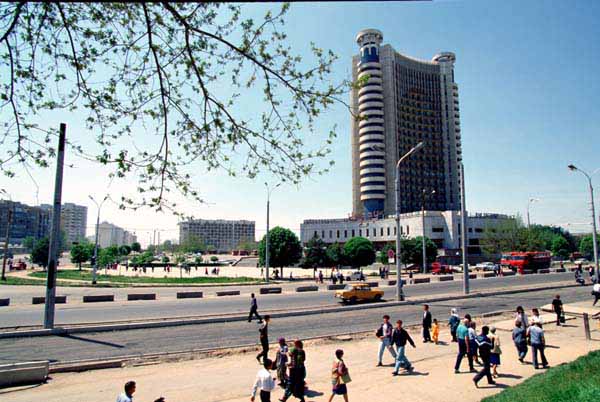
Town centre |
 |
|
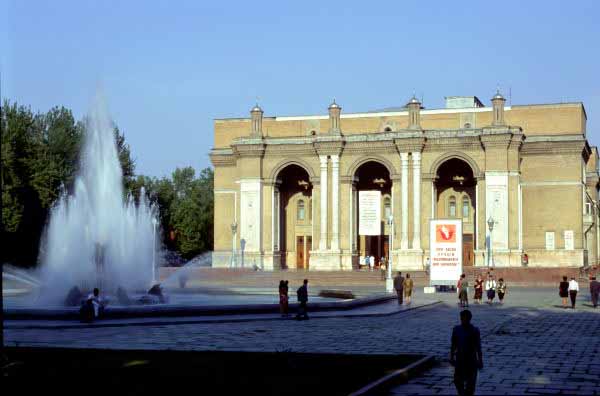
Navoï Opera |
 |
|
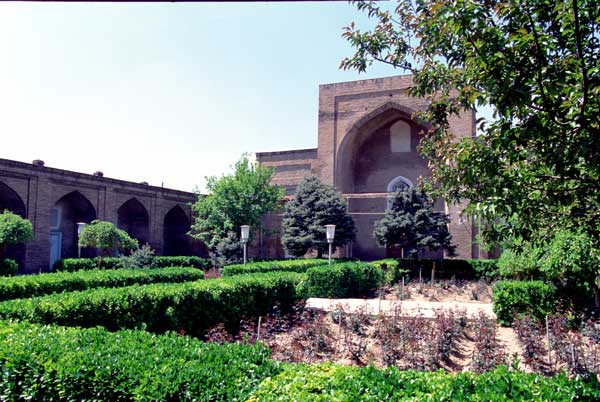
Medressa |
|
|
Approach: The Lufthansa flight lasted 6 hours from Paris to
Tashkent via Frankfort. It took off at 2:50 from
Paris and arrived at 11 pm (Paris time) at the international airport
of Tashkent. The time lag is three hours.
Tashkent,
the present city was rebuilt after the earthquake of
1966 which destroyed it almost entirely. Its town-planning is square
and the buildings are of Soviet type. Nevertheless it is very
pleasant thanks to its many parks and fountains.
It was a crossroads of trade route between Asia, the Mediterranean Sea
and Europe. It was the capital of Soviet Turkistan before becoming
the capital of Uzbekistan. With more than two million inhabitants,
it was the fourth town of the USSR.
The government of Uzbekistan tries establish its leadership on
ex-Soviet Central Asia and to give Tashkent its former glorious days.
Navoï opera: It is located on the Lenin square bordered by
parks, cascades and fountains. The Ali Chir Navoï theatre is
dedicated to operas and ballets. The greatest international singers have
performed there.
Kukeldash medressa, Jami mosque, Barak-Khan medressa and kaffal Chachi mausoleum:
These buildings were too much restored but they are representative of
the art of Central Asia.
The Aibek museum shows the history and culture of the people of the Republic of
Uzbekistan. Very didactic, it was
interesting to visit.
Goum and Tsoum: The department stores of the Soviet era
were worth a detour to see the articles sold there.
A subway station must be seen to make the comparison with the
Parisian subway. Its luxury of decoration, its depth and width are impressive. |
|
|
|
|
|
This first visit to
Tashkent did not leave an imperishable memory.
It was not the same as my trip in 1999 on the way to
Kyrgyzstan. The "Uzbekistan" hotel corresponded to the image of
ex-USSR hotels, badly maintained, with poor room service, slow restaurant
service and mediocre food.
|
|
|
|
|
Khiva |
|
|
|
|
Approach: The trip by plane from Tashkent to Ourgentch
lasted approximately an hour on an old Tupolev. One must
take risks! The
trip from Ourgentch to Khiva 32Km away took half an hour. The
visit of Khiva took approximately three hours, then I strolled among
the shaded lanes until 5 p.m. when I came back to Ourgentch.
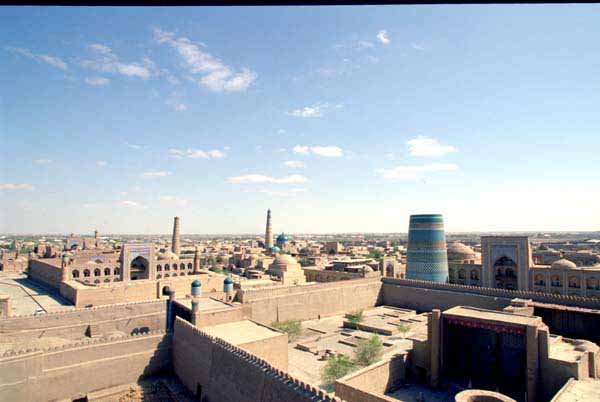
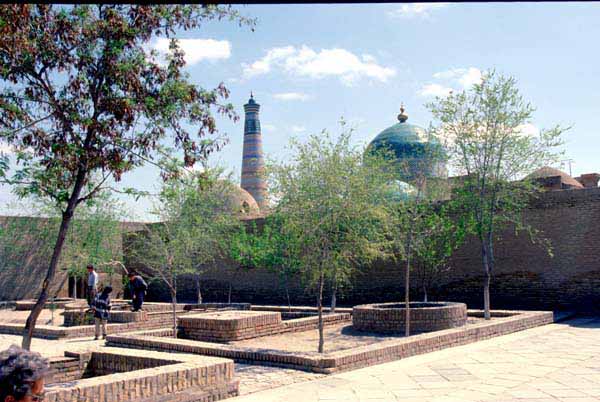
Khiva, Ichon-Kala: The city has the status of
museum city since 1968: no vehicle in the intramural old city
enclosed by a double adobe wall dating back to the 19th century.
This fabulous Eastern city is more a rebuilt city than a restored one.
The buildings are recent, 18th and 19th centuries. The buildingd I visited
buildings were:
The Khan Moukhammed-Amin medressa:
Built in the 19th century, it
is the largest in Khiva.
Kalta minor: Called the truncated minaret, the green tower,
it dates back to the 19th century.
Kukhna-Ark: As of the 17th century, it was composed of
the Chancellery of Khan, reception rooms, the Harem and
summer and winter mosques.
The Juma mosque: Travellers mentioned it as of the 10th
century, the building dates back to the 18th century. The prayer room
has 218 wooden columns some which certains dates back to the 11th century.
The Khan Went-Kouli medressa: It was built on a square where
the Khan's edicts were read and commented on.
The Koutloug Mourad-Inak medressa: Its originality lies in
the underground water tank that supplied the city.
Went Quli Khan caravanserai: The construction is massive and
ha strong towers at the four angles of the building.
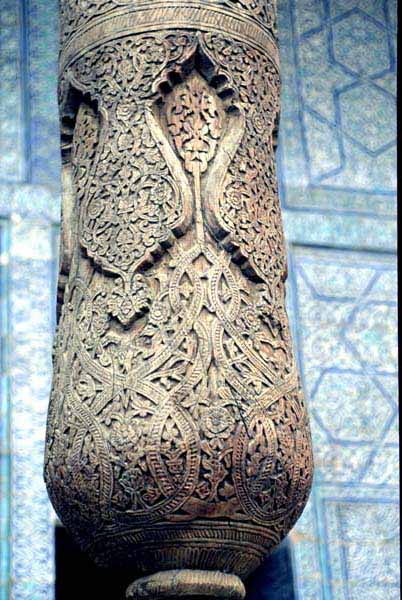
Tash-khovli, or stone palace, is a fortress built in the
19th century. It has several yards with private apartments and official rooms.
The iwans of the palace have fine carved wooden columns. The walls are decorated
with mosaics with geometrical drawings.
The Jaid Allaoudin mausoleum is one of the oldest monuments. It
was built at the time of the Gold Horde in the 14th century.
The Pahlavon-Mahmud mausoleum: It was built in
honour of the sporting exploits of a craftsman, then it became the
tomb of the Khans of Khiva.
The medressa and the minaret of Islom-Huja: The minaret
dominates all the city, the medressa has 42 rooms for students around
the square on two floors. |
|
 |
|
Khiva |
 |
|
Garden |
 |
|
Wooden sculpture |
 |
|
Prayer |
|
|
|
|
|
|
According to the legend, Khiva was founded by Shem Noah's son when he
discovered the site. He must have been ubiquitous talent considering
the number of cities that he may have founded. Nevertheless than Khiva
had a long and prestigious past. But its future is
limited to the statute of museum city, tidy and cold, even by forty
degrees centigrade in the shade. One needs much imagination to represent the
bustle of the bazaars and the poverty of time oh the Silk Road .
The dominant colour is turquoise, different from that of Bukhara and
Samarkand.
|
|
|
|
|
Bukhara |
|
|
|
 |
|
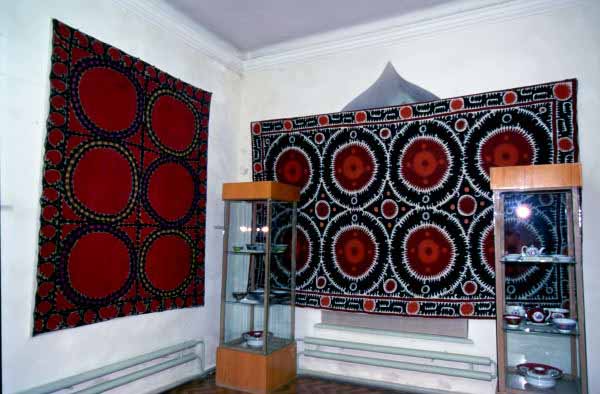
Divan Beghi |
 |
|
Modern tapestry |
 |
|
Oulougbeg medressa |
 |
|
Kalian mosque |
 |
|
Bal-Khaouz |
 |
|
Samanid mausoleum |
|
|
Approach: The trip from Ourgentch to Bukhara was made on a
Japanese minibus. It took nearly 6 hours to ride the 416Km between
the two cities across the Kyzyl-Koum desert.
Bukhara: The city is located at the crossroads of the caravan
trails in the middle of the desert. The temperature can reach 50°C. It is also a
museum city with 360 mosques. It entered history in 1st
century AD then in the 9th century it passed under the Samanides
rules. Around 980 Avicenna, Ibn Sina, wrote his major work
there the "Canon of medicine". Then the dynasties followed one
another, Karakhanids, Timurids, Shaybanids until 1868, date of the
joining to the Russian Empire. Bukhara has a very varied architecture according
to its dynastic history.
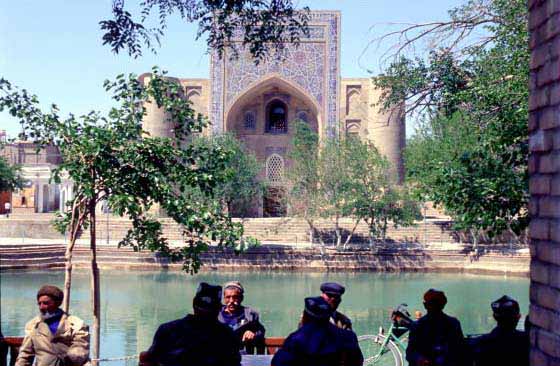
The Labi- Hauz complex dates back to the Timurid time, it includes:
The Kudeldach medressa (1568): The largest in Bukhara, it has 160
student cells. The building was entirely decorated. The entrance gate has
a double line of arcades.
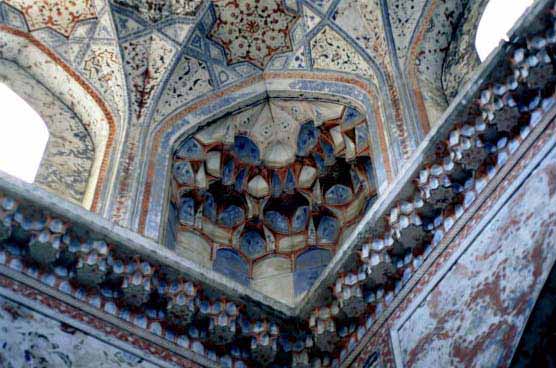
The Divan-Beghi medressa (1622): It has neither a conference room,
nor a library. Its interest lies in its outside decoration of birds and animals.
Khanaka of Divan-Beghi (1620): It is a monastery intended for
dervish pilgrims.
The Magoki-Attari mosque (12th Century): Located above the
level of the current street, the decoration of the brick
frontage recalls the work made for the Samanid mausoleum.
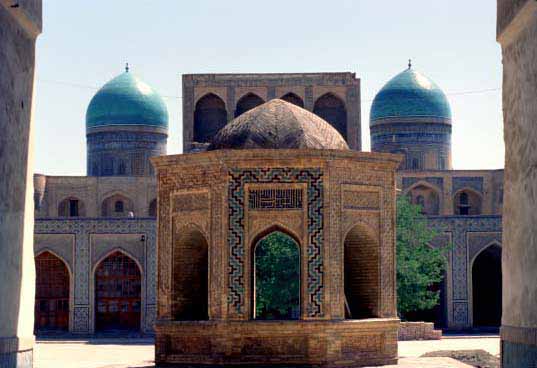
The Ulughbek medressa (1417): It was built by Tamerlan's
grandson, a great monarch, astronomer and poet. He had this written on
the gate:
"The duty of any Moslem man and any Moslem woman is to aspire to
knowledge"
The Abdulaziz Khan medressa (1652): Opposite the latter,
its promoter wanted to exceed all that had been done before him
in Central Asia.
The Poi-Kalian complex:
The Kalian minaret: 46 m high, it is the most
beautiful of Central Asia.
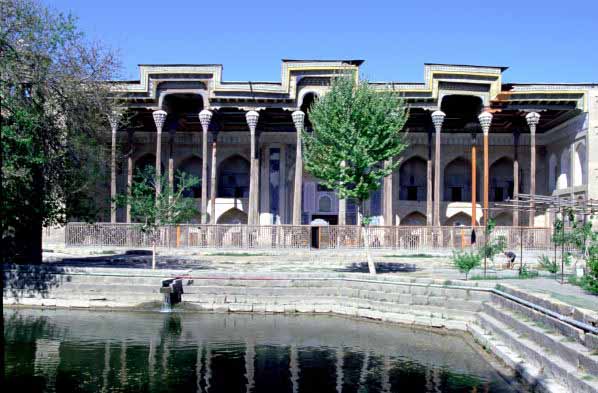
The Kalian mosque: The prayer room has 208 pillars
supporting 288 cupolas. It is the vastest of Central Asia, 10,000
people could listen to the Imam's sermon.
The Miri-Arab medressa (1530): It has 111 cells distributed
around a square court with bevelled angles.
The Bal-Khaouz complex:
Ark: The citadel was built on the site of a former
fortress. The monument dates back to the 16th century and was the
Emirs' residence.
The Ball-Khaouz mosque: Built in 1712, it has an iwan with
columns and a remarkable coffered ceiling.
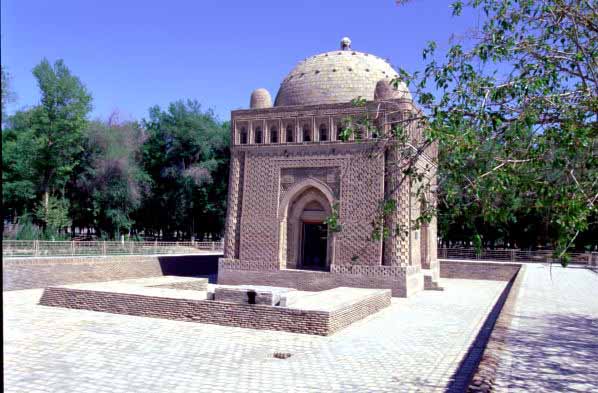
The Ishmail Samani mausoleum: Built by Ismail for his
father founder of the dynasty, it is the jewel of Bukhara. The
fitting of cooked bricks simulates an object in basketwork.
The Tchachma Ayyub mausoleum: Built about 1380 by order
of Tamerlan on a source that sprang when prophet Job struck the
ground with his cane, it has different cupolas according to the
time of contruction.
Sitorai Mokhi Khossa: This building was the Emir's summer palace.
Tchor Minor: This building remote in the city was built in 1807
at the entrance of a disappeared medressa. It is a
cube flanked by four minarets with turquoise cupolas.
Berakshah:
The city is a Zoroastrian old city built in the desert.
Charbakr: The
city is a ghost-town in the desert. |
|
|
|
|
|
Bukhara has the austerity of the brown colour of these one thousand year old
buildings. It is remarkable for the prestige of the buildings of the
centre and by the number of medressas making of this caravan crossroads an important
cultural centre which shone on all Central
Asia and where many Moslem scholars were born and taught.
|
|
|
|
|
Samarkand |
|
|
|
|
Approach: The way 280Km was made on a very beautiful
road which allowed us to admire the panorama and to visit a caravanserai,
of which only the immense gate and a well are left.
Samarkand:
The arrival was around 6 p.m. at the "Samarkand" hotel
magnificently located to take photos of the monuments in low angle light.
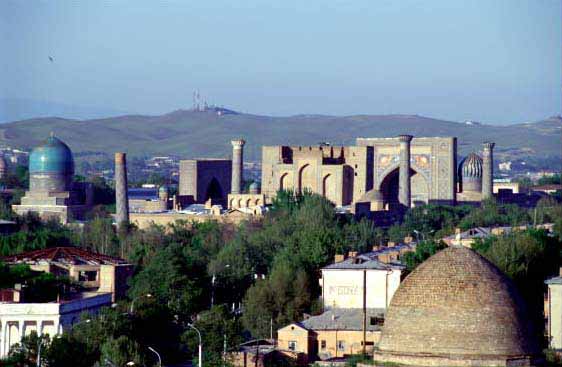
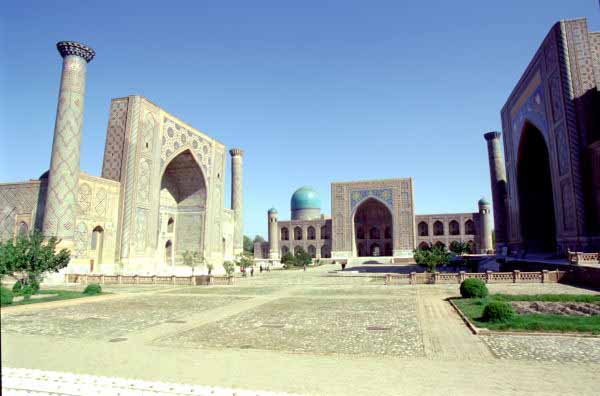
Registan, at Tamerlan's time,
was the square where the caravans gathered arriving by six large
avenues. Ulughbek had the medressas built in the 17th century to
assume the cultural influence of the capital in Central Asia.
The set is majestic:
The Shir Dar medressa: It stands of opposite the Ulughbek medressa. On its
tympanum tigers are represented in the middle of an abundant floral decoration
that give it its name.
The Tiliya Kari medressa:
The last built medressa closes the Registan square. Its interest lies in
its mosque whose cupola dominates the square and whose inside in white
marble is decorated by paintings and gilding. Therefore its name,
"covered with gold".
The Ulughbek medressa: It was the most important university
in Central Asia and the most eminent teachers such as
Kadi Zade Roumi, taught there. The tympanum of the monumental
gate represents a stylized and spangled sky with two decorative minarets.
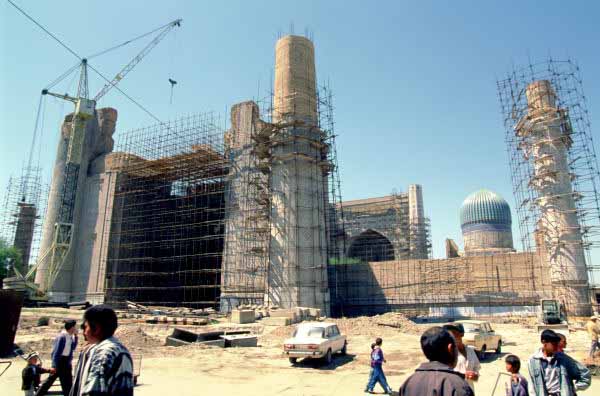
The Bibi Khanym mosque: Beyond the legend imputing the construction to the
preferred wife of Tamerlan, it was really built by Tamerlan's order as
back he came from the campaign in India subjugated by the
mosque of Delhi. It was the vastest of its time. Tamerlan had craftsmen
come from all the conquered areas. The gate opens on a yard
with four iwans with an engraved marble lectern in its centre. The
cupolas of the minarets and of the mosque are covered by glazed bricks
of turquoise colour.
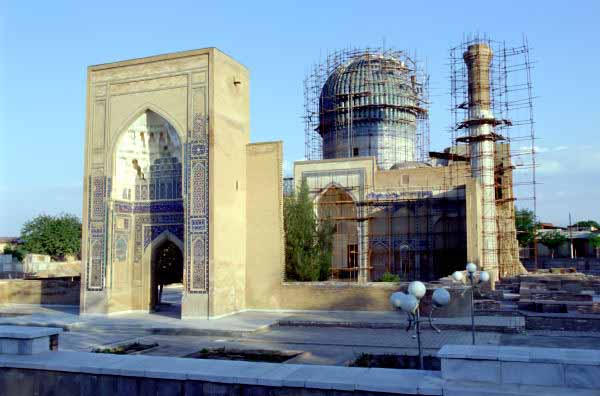
Gour Emir: The Timurid mausoleum was built by Tamerlan's order at his
grandson's death, Mohamed Sultan. Finished in 1409, it received the remains
of Tamerlan and Mohamed Sultan. The mausoleum was closed due to restoration.
I visited
Gour Emir at the time of my tour to Kyrgyzstan in 1999.
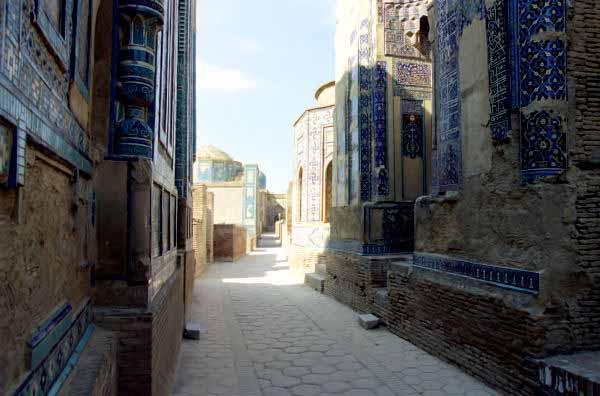
Shah-I-Zinda: The necropolis is located at Afrasyab, at the border
of medieval Samarkand. As of the 11th century, it took its current
configuration back to 1370 when Tamerlan made of it the necropolis
for his family and his Generals. It is a long lane on hillside lined with
mausoleums. The monumental gate opens on a forty-step staircase going up to
the alley of the tombs ten of which are in good condition.
Ulughbek observatory: It was built in 1428. Only the underground
part of the sextant is left. Ulughbek was assassinated partly for his efforts
to develop sciences. He wrote a treaty of astronomy which made wonder in its time.
Afrasyab: Samarkand was known by the Greeks under the name of
Marakanda in the 6th century BC. Alexander the Great invaded it
in 329 BC. Under the Kushan dynasty, it became Afrasyab, an important
stage on the Silk Road. A museum recalls the history of the site.
Kharzet-Khyzra mosque: The foundation refers to the
anteislamic period. Away from tourist attractions, its visit
is interesting for its Abbasid primitive plan. |
|
 |
|
Samarkand |
 |
|
Reghistan |
 |
|
Bibi Khanym |
 |
|
Gour Emir |
 |
|
Shah-i-Zinda |
|
|
|
|
|
|
Samarkand was a rapture, the dominant colour is turquoise blue. The size
of the city and the situation of the monuments allow visitrs to stroll there
at leisure admire the site and see the daily life of the people.
|
|
|
|
|
Shar-i-Sabz, Termes, Pendjikent |
|
|
|
 |
|
Kok-Gumbaz cupola |
 |
|
A market |
 |
|
Bridge to Aghanistan |
 |
|
Roudaki museum |
|
|
Approach:
The way from Samarkand to Chakhrisabz 85Km was made in two hours.
Shar-i-Sabz:
The city, former Kech, was the birth's place of Tamerlan (1370), the governor's son.
Tamerlan equipped its birthplace with sumptuous buildings but very few are left.
The city is located at the foot of the Zeravchan mount 658m high.
The Ak-Saray palace: This palace built by the craftsmen from Khazrem,
there remains only the immense gate decorated with earthenware mosaics.
The Timurid mausoleums: Among those one received particular attention:
Dar Al-Siyadat received the remains of Jahangir Tamerlan's son.
The square crypt intended for Tamerlan buried in Samarkand. The Aldine Shams Kulala mazar
for Tamerlan's family -his father- and the tombs of the descendants of Oulough-Bey.
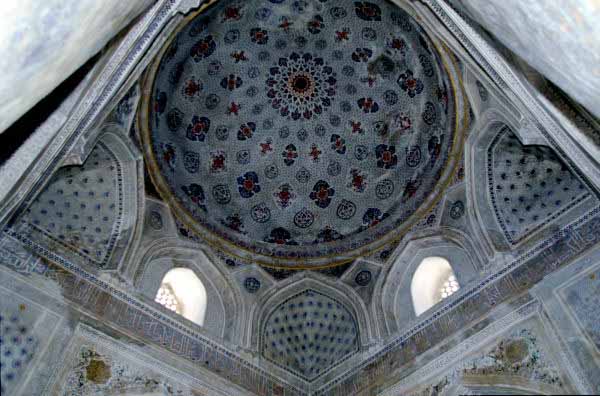
The Kok-Gumbaz mosque: Built by Ulughbek in 1454 in homage to his father Cham-Roukh,
Tamerlan's son, has a monumental gate decorated with mosaics.
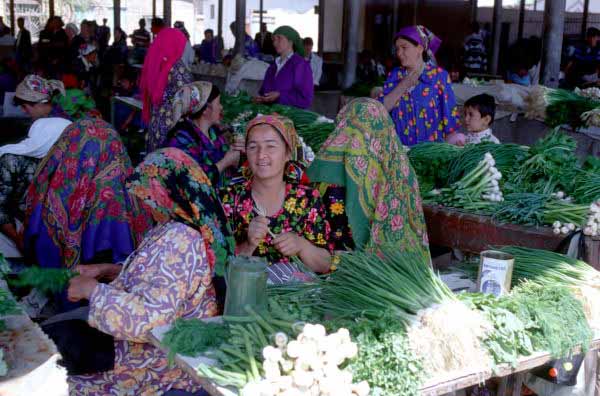
The Chorsou market: It is covered with five brick cupolas.
Termez:
The city a 6-hour ride from Shar-i-Sabz is located in former
Bactrian on the bank of Amou Darya, a border with Afghanistan.
The Hakim Al-Termesi mausoleum: It was built on the site of a Buddhist temple.
The inside decoration of the cupola is remarkable for its the geometrical drawings.
Fayaz Tepe: The archaeological site dates back to the Kushan
empire at the beginning of the Christian era. The Buddhist influence
was very important, Termez remains a venerated place of pilgrimage.
The Saadat Sultan mausoleum: It was built in the 11th
century.
The summer palace of Kirk Kiz: The building was a fortress.
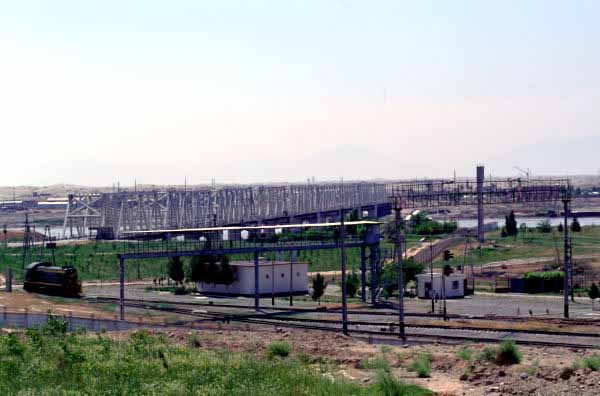
The bridge of Friendship: It crosses over the Amou Darya
to go to Mazar-i-Sharif in Afghanistan in the Bactrian plain whose capital
is Balk, former Persian Bactres.
The
excursion to Pendjikent, 68Km away from Samarkand, required crossing the border
to Tajikistan by the very beautiful valley of Zeravchan among the cotton fields.
The river is the border between the two countries. The crossing of the border
did not pose any problem.
Penjdikent: The city is located 1,000m high. Founded in the 5th century
by Hephtalit princes, it was for two centuries the centre of the Sogdian civilization.
The fortified city had several temples and many aristocratic residences.
The Indian influence, Shivaism, the Iranian influence, Zoroastrism, and Buddhism
showed the intellectual attitude of Sogdians: They invented ecumenism.
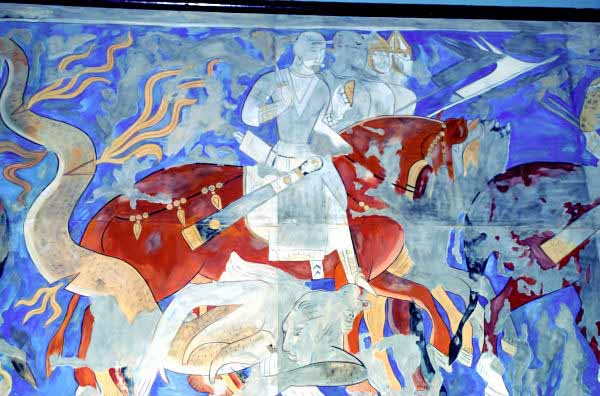
The Roudaki museum exhibits outstanding frescos and artefacts coming
from excavations. |
|
|
These two cities, away from package tours, allowed me to approach the population
of "Deep Uzbekistan". People readily let themselves be photographed if
asked politely. The scenery are dramatic, the dominating colour is sienna. The archaeological
sites need restoration. Hotels are very bad. It took eight hours to go back to Samarkand.
Pendjikent was an excursion of a half day from Samarkand. Was it quite essential? Yes, to admire
the frescos and the reconstitution of the life in Sogdian exhibited by the museum.
|
|
|
|
|
|
|
|
The journey to Uzbekistan was an escapade to
three mythical cities on the Silk Road to meet Tamerlan who wanted to
reconstruct Genghis Khan's Empire for his profit.
Although the two men resembled each other as destructors and plunderers.
They were quite different, the Mongol organized the conquered countries,
the Turk left the countries with the spoils. Both empires were ephemeral.
It was the same with another descendant of these warriors, Bâbur Shah.
The monuments which testify to former splendour do not say anything about the
living conditions of the population.
|
|
|
|
|
The return to France was made by a Lufthansa flight
with a departure in the morning and an arrival in Paris in the morning.
|
|
|
|
| Neuilly, le 2003/12/28 |
|
|
|
|
|
|