|
|
 |
Kyrgyzstan, Lenin Peak |
|
The journey to Kyrgyzstan was an expedition
to attempt the ascent of
Lenin Peak, 7,134 m high. The 18-day
walk for a 29-day journey was divided in three parts.
The group was composed of
7 people accompanied by a high mountain guide from Chamonix.
The expedition was in 1999, from July 31 to August 28. After a Uzbekistan Airways flight,
the arrival at Tashkent was on time.
The report is in five
tables. The general comments are given by the
Kyrgyzstan presentation. |
|
|
|
|
Tashkent, Osh, Achik Tash |
|
|
|
 |
|
Dog days |
 |
|
Ferghana valley |
 |
|
Scenery |
 |
|
Base camp |
|
|
Approach: The Uzbekistan Airways flight lasted 6 hours from Paris
to Tashkent via Amsterdam. It took off at 5:30 pm from Paris to
arrive 2:30 am (Paris time) at the international airport of
Tashkent. The time lag is three hours.
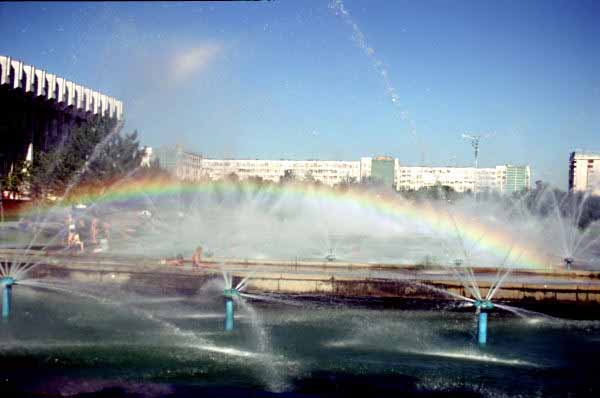
Tashkent: The city is modern. It was visited when we returned from.
Approach: The way from Tashkent to Och was made on a bus to
the border of Uzbekistan and Kyrgyzstan then by two vans to Och.
It lasted 10 hours including stops for approximately 360 km.
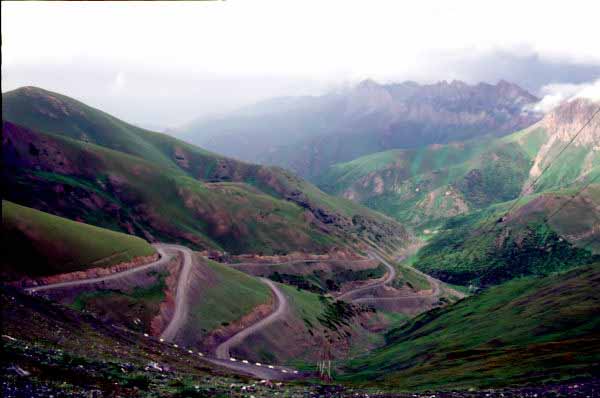
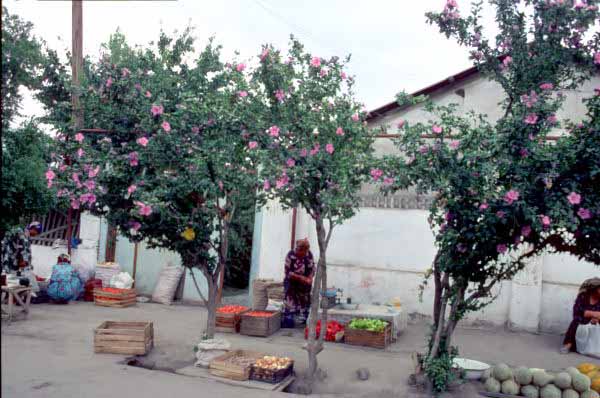
The road runs through the mythical Ferghana valley where
according to the legend "the celestial horses sweated blood".
It is divided into Kyrgyzstan and Tajikistan! As of 140 BC,
the Chinese Emperors of the Han dynasty sent embassies to get
these horses in order to equip their armies.
We had lunch at Kokand, the capital of eponymous Khanate in the
18th and 19th century.
Och: The city is located in Kyrgyzstan a few kilometres away from
the border. The Uzbek community is very large. Ethnic clashes
occurred in 1990, before the independence of the Central Asia Republics.
The city was visited when we returned from the expedition. It looks
modern and with Soviet architecture.
Approach: The way from Och to Achik Tash was by truck,
ex-military off-road truck of the Soviet army. A cell with
wooden seats was set up on the dumper of the heavy vehicle.
The way lasted more than four hours for an unknown mileage.
-- the first part was by an decent road in the dramatic
landscape of Pamir,
-- the second part, more than one hour, was off-road with
crossing over fords.
The roughness and the rusticity of the vehicle made this trip
particularly painful.
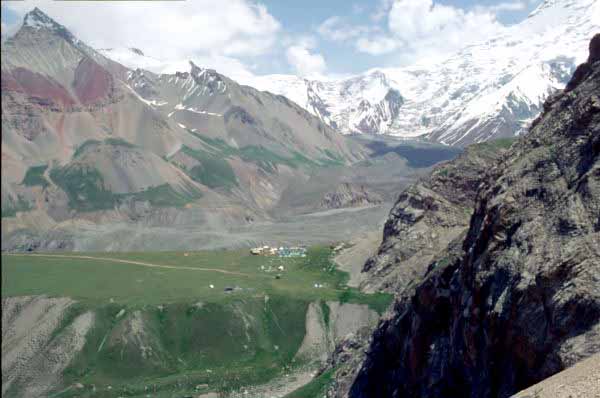
Achik Tash: The base camp is located 3,600 m high. It
is managed by a travel agency, Asia Travel of Tashkent. It
set up tents and cooks the meals in a Yurt. The camp
has a medical department, in a white tent, any candidate to the
Lenin Peak ascent must imperatively have
a medical examination after the three-day acclimatization. The
doctor or male nurse maintained in operating condition a sauna whose
stones are heated by a rudimentary oil-burner supplied with a drip!
I did not know that I was spend a number of days there. |
|
|
|
|
|
A Three-day acclimatization was spent at the base camp. The first
was one day of total rest, preparation of the material and briefing
of the base camp chief. The next two days were devoted to half-day walk
around the base camp with a difference in height of 800 meters.
The medical examination was made afterwards. |
|
|
|
|
Intermediate camp |
|
|
|
|
Approach: The trip from the base camp to the intermediate camp
was in four sections.
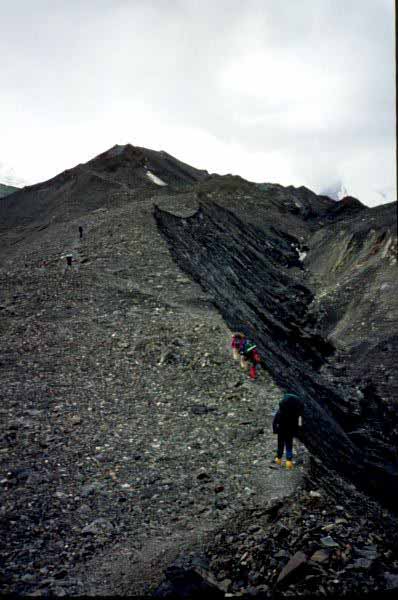
-- the first to cross over the Puteshestvinikov pass 4,150m high,
-- the second to go down towards the left moraine of the Lenin glacier,
-- the third to go up the Lenin glacier,
-- the last to move towards the intermediate camp on the moraines.
The ascent took five hours and the descent to the base camp took three
hours. The purpose of an expedition is to make outward
trips and returns to the various intermediate camps to convey the material.
Two outward trips and returns were made and finally a rest day.
Intermediate camp:
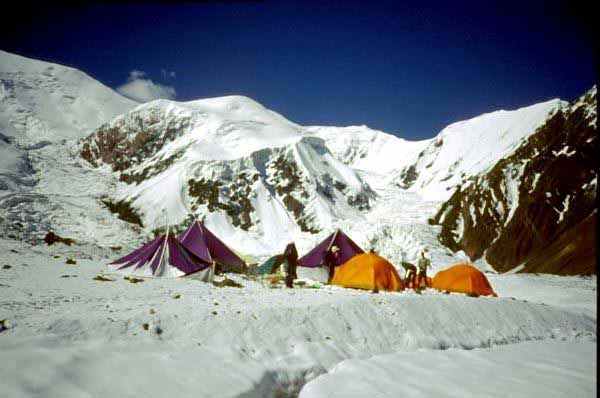
It is set up on the lateral moraine crest of the Lenin Glacier.
It is between 4,200 and 4,300 m high. The infrastructure is the
last managed by Asia Travel, the meals are
included in the fixed price of the ascent permit.
Moreover a high mountain guide of Asia Travel ensures the
safety, the monitoring and certification to have reached the top of
the Lenin Peak.
The fourth day at the intermediate camp consisted in achieving the acclimatization phase
by climbing a part of the track to reach the altitude camp n°1 5,300m high.
It had snowed a lot. The objective was to go up as far as the turn right towards
camp n°1 5,100m high approximately, that is to say the first two sections of the trip.
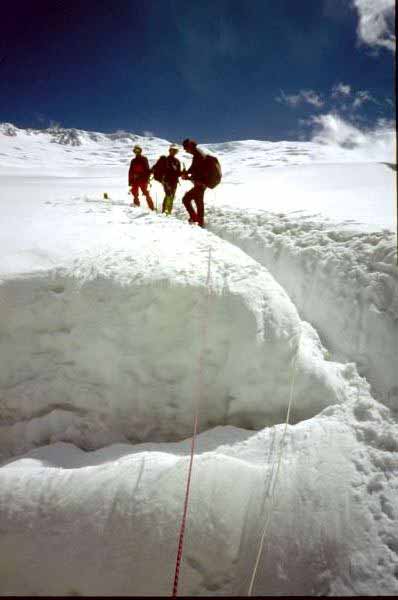
-- the first, along the glacier, has many crevasses to reach the slope,
-- the second, the slope about 40 to 45%, has very wide and deep crevasses.
The ascent required to fit the crampons in a deep snow up to our thighs.
A rope was set up by Asia Travel.
The difficulty made the ascent painful, I stopped around 4,800 m high
admiring the Lenin glacier. The return to camp n°1 was terrible. |
|
 |
|
Moraine |
 |
|
Intermediate camp |
 |
|
A crack |
|
|
|
|
|
|
After the ascent of the first difficulty, I spent the night thinking
of my personal goal taking in account the group's goal.
An outward journey and return were envisaged towards the
camp n°1 to convey the collective and private material.
It appeared to me that I would have many difficulties assuming my
transport part of the collective material in addition to my personal equipment.
In the early morning at the time of the briefing, I announced my decision,
dead to shame, to throw in the sponge and to go down back to the base camp.
I spent nine days at the base camp waiting for the return of my friends
wishing that they had made a successful ascent. Whzn they returned,
I learned, unfortunately, that they had not been able to reach the top for
climatic reasons. |
|
|
|
|
Osh |
|
|
|
 |
|
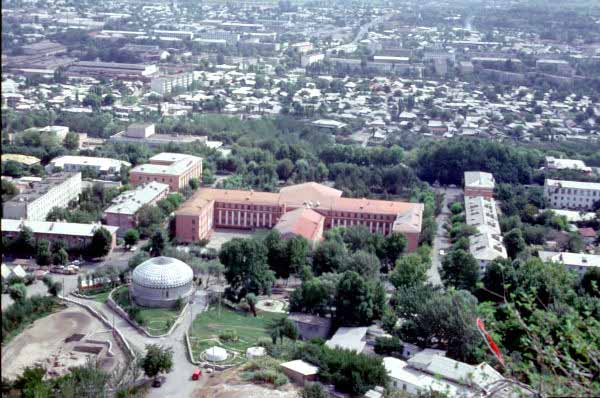
Osh |
 |
|
Solomon's throne |
 |
|
Woman at a market |
|
|
Approach:
The trip from Achik Tash to Och was made on the same truck as for
the outward and under the same conditions of painfulness
compensated by the dramatic landscapes of Pamir. The road crosses
the Kyzyl-Suu valley from west to east with the snow-capped tops
of Pamir in the south. The valley is from 30 to 50 km wide.
Many police checks point were made as we transported
a clandestine young Fin going back to his country.
We arrived around 7 p.m. at the same hotel before.
The temperature was 30°C.
Osh:
One day of relaxation was devoted to the visit of this city in the Ferghana valley
that the nonsense of Stalin's policy divided between the three Republics,
Uzbekistan, Tajikistan and Kyrgyzstan.
This valley is mainly populated by Uzbeks. Osh is located at an important
crossroads of the Silk Road, there was nothing to see. Nevertheless it preserves
its statute of crossroads thanks to road M41, Pamir Highway, with Tajikistan,
then from Sary-Tash and the Irkeshtam border post with China to Kasha.
The few sights we visited were:
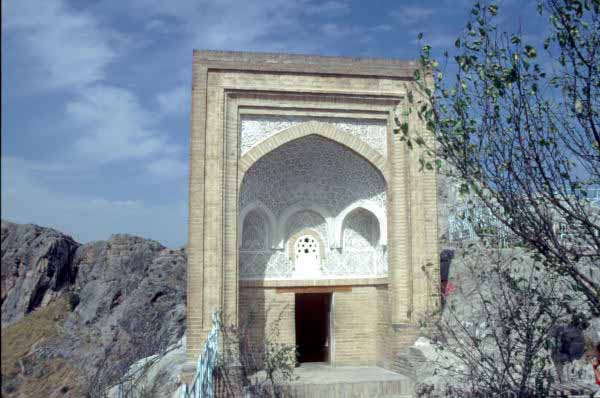
Solomon's throne, located on a jagged hill overhanging
the city, is a Moslem pilgrimage place supposedly prophet Mohamed
prayed there! In 1497 14-year-old Babur, who was to found
the Mogul dynasty of Delhi, had a mosque built but it was destroyed several times.
The promontory offers a beautiful view on the oasis occupied by Osh.
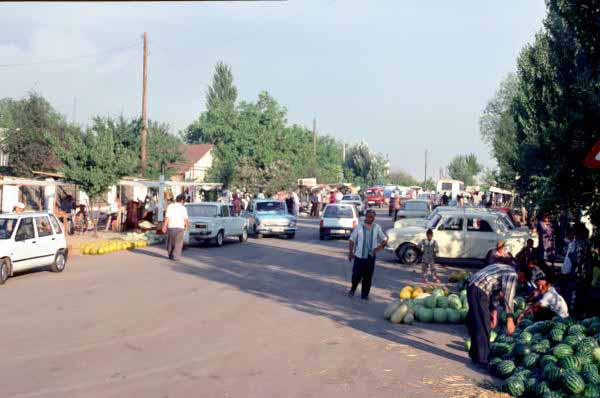
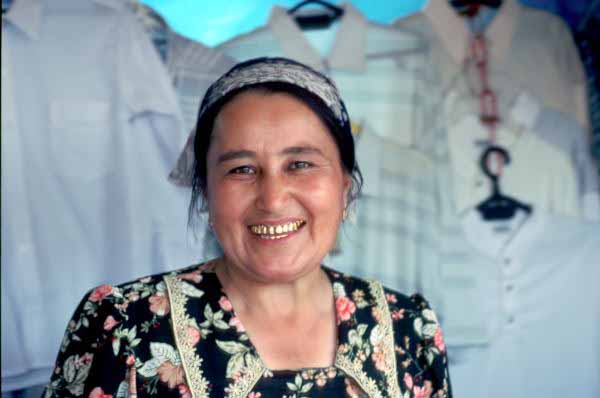
The market in the open air is one of the vastest of Central
Asia. The three main ethnic groups are present here, Uzbek,
Kyrgyz and Tajik.
The park, along the river, offered one moment of rest at the
foot of a Yak-40 carcass on its pedestal: Not so restful
due to the crowd of the accompanied children and the many carousels. |
|
|
|
|
|
In the Ferghana valley, the tangle of the borders between the three
countries raises questions about the future of the ethnic groups split
between them. Afghanistan and Pakistan are dangerous neighbours
anything good to become to this area. Except if the leaders agreed to
speak about it without hegemonic back thought, one can have a dream.
|
|
|
|
|
Tashkent |
|
|
|
|
Approach:
The trip from Osh to Tashkent was made on a Japanese minibus
and lasted nearly nine hours including lunch at Kokand,
the same restaurant as for the outward journey. Ten kilometres
away from Osh, the Uzbekistan border and police control
did not require less than one hour, so much the number
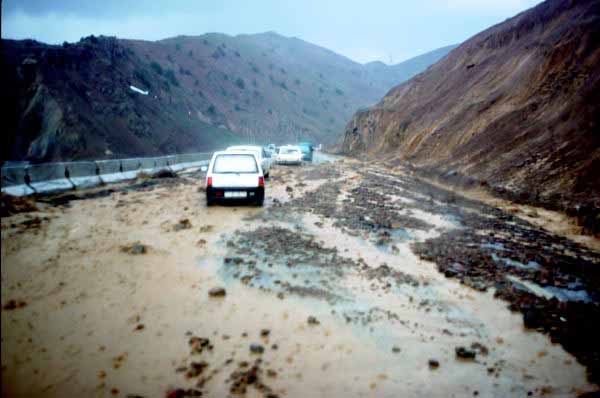
of vehicles of any kind was large. After Kokand, the crossing over a
pass 2,130m high under a pouring rain on a road made
marshy by widening work was made in an indescribable disorder due to the
number of vehicles overloaded and stuck in the mud.
Tashkent:
The city has remained the most important crossroads of Central
Asia. It knew many names during its long history,
Shash, Shashkent then Toshkent in the 11th century. Now it has became the
"Central Asia's Hub" to all the world destinations. It
was visited at the time of the journey in 1993,
Tashkent.
The new city, as I had already noted, is Soviet style.
Broad avenues, large spaces, many parks give the
city its modern aspect, but unfortunately all is neglected
without maintenance, for lack of financial means or disinterest.
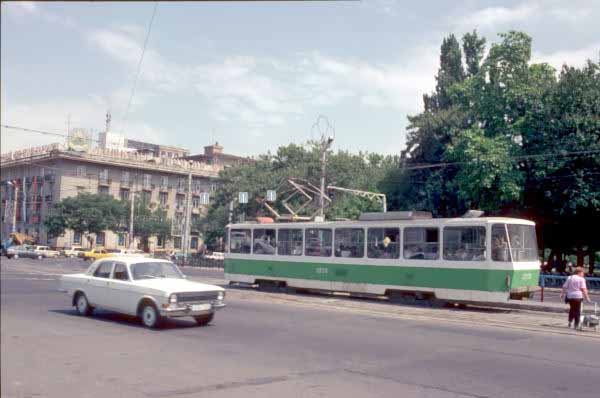
The tram cars, the trolley buses which we used were wobbling.
There are very few private cars.
The subway, that we also used, was the occasion of one of my jokes.
I took a photo, unfortunately the flash worked. At once two
police officers fell on me and I was taken to the police
station of the subway where I remained more than one hour during
which the police officers controlled my passport, gave many phone calls,
and finally let me free berating me in a language that I identified as
being Russian. I was afraid that they would confiscate my camera or remove
the film, but not at all. I must admit that the photo is bad!
The old city was visited again. It does not have anything
comparable with Samarkand. |
|
 |
|
Road in the Ferghana valley |
 |
|
The pass in the rain |
 |
|
A tram |
|
|
|
|
|
|
Tashkent is not part of the myth of Central Asia's Cities.
It has become an international city too early. I noted, in three years later
that modernity had settled there with the clothes of young people and
even of girls in Muslim land, American fast food, busy street. The Western way
of life has followers. |
|
|
|
|
Samarkand |
|
|
|
 |
|
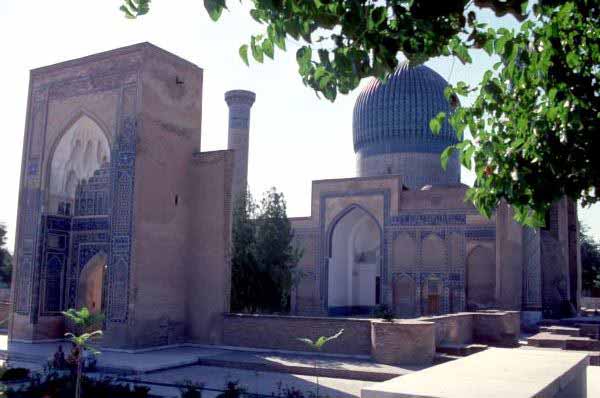
Gour Emir |
 |
|
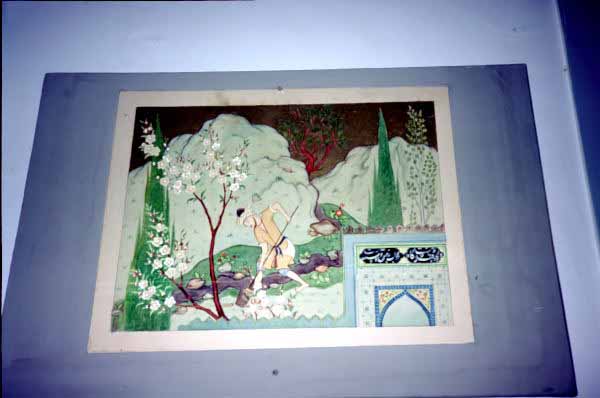
Picture |
 |
|
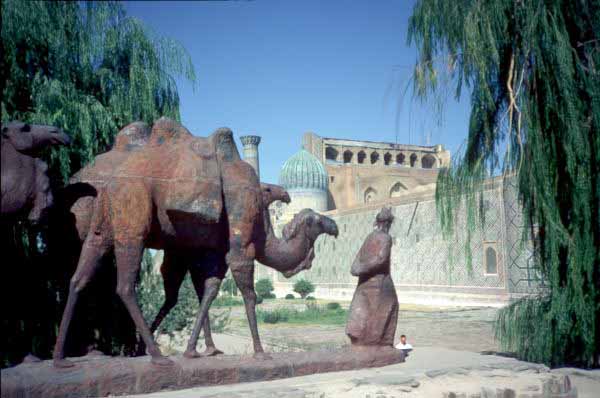
A caravaneer |
|
|
Approach:
The time assigned to the journey left two free days which we decided
to use to visit Samarkand. The trip from Tashkent to Samarkand was
made on a minibus and lasted a little more than four hours for
300 km on a road with four lanes most of the time but terribly bumpy.
Samarkand:
The arrival was around 12 noon at the "Zeravchan" hotel not as well
located as the "Samarkand" hotel of the previous journey.
We visited the same monuments,
Samarkand. Between these two journeys, the city council did a lot
to improve the city. The restoration of the monuments has made a lot of progress.
At the time of this visit, Music Festival was inaugurated
with great pump by the President of the Republic.
Gour Emir: The Timurid mausoleum
was built by Tamerlan at his grandson's death, Mohamed Sultan.
Completed in 1409, it contains the bodies of Tamerlan and Mohamed
Sultan. The mausoleum was closed due to restoration in 1996. the works
being completed, the monument was opened to tourists, I could
admire the inside of this sumptuous building.
The inside panels are in onyx, the handrail of the tomb stone is
in alabaster, the tomb stone is in jade. The cupola is
covered with gold sheets and lapis lazuli.
In 1941, Mikhail Gerasimov opened the crypt and noted that indeed
Tamerlan was lame in the right leg and right arm. Moreover, it was
1,7 meters tall.
Bibi Khanym:
The works of restoration of the large mosque were almost completed. I think
that now at the end of 2003, there are. |
|
|
I visited again Samarkand city with much pleasure. It is, par
excellence, the legendary city of Central Asia. Like Khiva and Bukhara,
it emerges out of the desert like a mirage with its cupolas, its minarets,
its mosaics of a turquoise blue that time has not faded. Unquestionably
the caravaneers of the Silk Road were subjugated by such beauty. |
|
|
|
|
|
|
|
The journey to Kyrgyzstan made realise my limits in climbing,
the "Seven Thousand" are inaccessible to me as much for physical
reasons as for technical reasons, I don't master walking on rope in
deep snow with crampons on a 45% slope. Nevertheless that I kept
plan to climb the "Six Thousand".
The future confirmed my capacities at this altitude. |
|
|
|
|
The return to France was by a Uzbekistan Airways flight with
departure in the morning and arrival in Paris in the morning. |
|
|
|
| Neuilly, le 2003/12/31 |
|
|
|
|
|
|