|
|
 |
Yemen,
the incense
road |
|
The journey to Yemen was a package tour organized by a French agency.
It was part of a programme of visits to the Middle-East to discover
the roots of Christian Western and the Moslem Worlds.
The group was composed of 14 people. A French woman guide, a specialist in the
Middle East, accompanied us.
The trip was made in 1993,
from February 12 to March 01. After an Yemenia Airways flight, the
arrival in Sana'a was on time.
The report is in eight tables. The general comments are given by the
Yemen presentation. |
|
|
|
|
Sana'a |
|
|
|
|
|
|
Approach: The Yemenia Airways flight was cancelled and delayed
to the next day. The first night was spent in a hotel at Orly. The
following day, the flight scheduled at 9:45 a.m. took off at 5:15 p.m.
to Sana'a via Larnaca. We arrived at Sana'a about 1:30 a.m. the
following day!
The approach time from beginning to end was 31 hours.
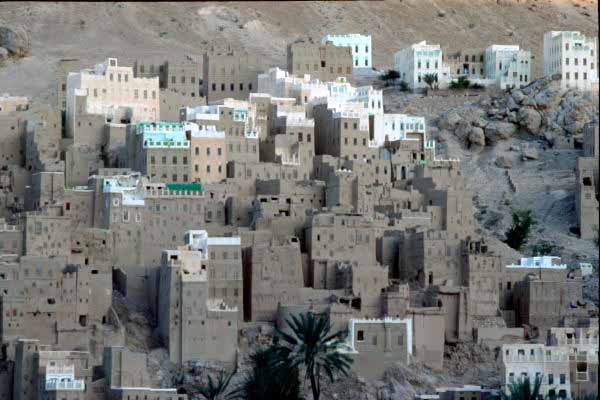
From Sana'a, the road to Wadi-Dahr crosses a green valley planted with vine and qat
to reach the two villages among the most beautiful and representative of the Yemeni
architecture.
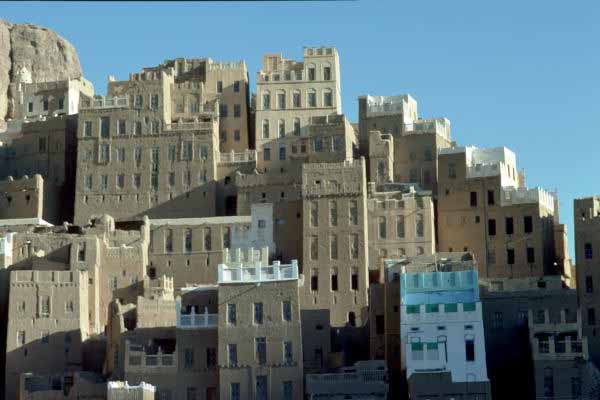
Thula: The village, 2,700 m high, is a perfect example of Yemeni architecture.
Built at the foot of a cliff, the city is surrounded by ramparts opened in four gates
including two with zigzags. The multi-storey sandstones houses
stand close to each other with frontages richly decorated witrh friezes.
Stroll me in the lanes was a constant discovery of thousands of splendours.
Kawkaban: The fortified village is built on a cliff
dominating the town of Shibam. This impregnable village was our
stopover for lunch in a restaurant over the valley.
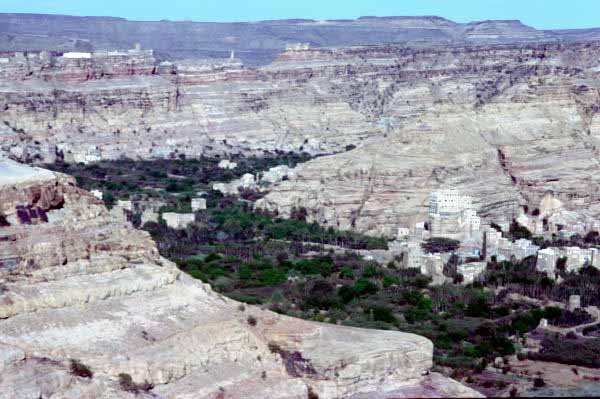
Shibam: The village was discovered during a walk from Kawkaban. It dates
back to the preislamic time on the caravan route from Ma'rib to the
Red Sea then to Axum the capital of Ethiopia at that time.
We headed north to Sa'da by the Eastern
slope of the mountains, we rested two days in this area.
Sana'a: Before leaving,
we spent a few hours in the old city, we visited the souk
in a splendid sun lighting the frontage of the houses.
The city was visited back from Ma'rib during a long walk where we could
admire the beautiful frontages of the old city buildings.
Amaran: It was our stopover. We visited it the next day going up
to Sa'da.
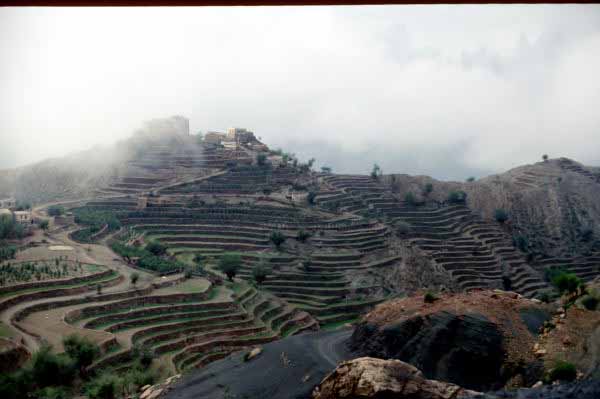
Kohlan: We reached the village, 2,400 m high, in the clouds climbing down
the western slope of the plateau on the Tihama plain side. It is very attractive.
Some houses have kept remarkable stone moucharabiehs.
Hajja: It was raining when we stopped at this village 1,800 m high. |
|
|
|
|
|
This package tour was exceptional due to the personality and competence of
our guide. Some visits were made with short walks around villages or
going from a village to another one. Moreover in the southern part of the country,
Hadhramawt, bivouacs replaced stays in hotels. |
|
|
|
|
Sa'da |
|
|
|
|
Approach: On the ay to Sa'da we crossed many typical
villages, al-Qabai, al-Harf and a lot more in a clear sandstone
landscape and with adobe multi-storey houses.
Amran: The city is built in adobe, it has been known since antiquity.
The multi-storey ochre houses of have white window frame, the panes are
plates of alabaster and sometimes the lintels have inscriptions in
south-Arabic. The market is worth the visit in the morning at the arrival of
the freshly cut qat.
It was again our lunch stopover and on back to Sana'a we spent the night there.
Sa'da: The road was long and difficult, we reached the city at twilight.
I visited it the next morning and had breakfast strolling in the lanes.
The city built on the plateau 1,800m high is a crossroads between Yemen and Saudi Arabia.
The square houses in adobe are massive and less tall than those out of stones.
The same colour as the earth, they are in harmony with the landscape. |
|
 |
| Amran |
 |
|
Saada |
|
|
|
|
|
|
The only exception to the technique of construction
in Sa'da is the mosque built out of ochre stones and its cooked brick
minaret. It is the sanctuary of the first Zaydi Imam of Yemen. |
|
|
|
|
Al-Hodayda |
|
|
|
|
|
|
Approach: This trip from Amaran to al-Hodayda went through Sana'a
to join the road to Tihama. It was a very pleasant day in the high mountains
of Jebel- Harraz. All the villages we saw have stone houses.
Manaka: This large village occupies several hills with houses set up out
of dry stone of various colours. The windows are surrounded by
guss, sandstone plaster. It is the excursion base camp of Western tourists.
Al-Hajjarah:
The city is like a set of multi-storey houses bound on a large rock.
A military city in a strategic site, it dates back to the 12th century at
the time of the Sulayhid dynasty. There are beautiful architectures of ochre
stone houses of four to five storeys. One of the most
beautiful examples of the mountain architecture.
Al-Khoteib:
The city was the Ishmaelites' impregnable refuge at the time of
their persecution by the Zaydi Imams. It is a true eyrie.
Al-Hodayda:
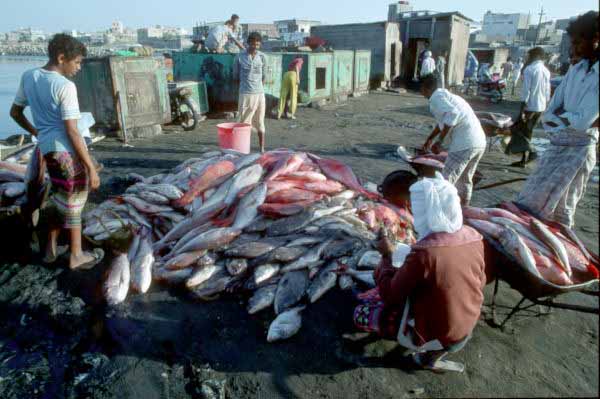
The city, the second large city in Yemen, is a port on the Red Sea built in
the 20th century after the al-Mokha decline. From the former city,
only the palace of the Governor is left. The souq is the busiest
in Yemen and more particularly in the morning when the fishing boats arrive. |
|
|
|
|
|
The landscape of this part of Jebel-Harraz is a set of scattered hills
on a plateau, each of them surmounted by a village. The building
material is sandstone and basalt, bonded with much care exploiting
colours in geometrical motifs. It is possible, recommended, to hike from
village to village.
The plateau is covered with terrace cultivation divided into sorghum,
wheat, rye etc. without forgetting qat.
|
|
|
|
|
Taez |
|
|
|
|
Approach: It was a long day on the road in the Tihama plain
to go up to Taez, (Ta'iz).
Bayt-al-Faqih: This small town is famous for its weekly market on Friday, we
were there. It has kept the charm and odours of typically
eastern spices. It was one of the protagonists of the fights which
opposed the area to Zaydi Imams. This epic was reported by
Joseph Kessel in "Fortune Carrée".
Zabid: Founded in 800, it was famous, it has beautiful vestiges.
The Koran school, medressa, may be at the origin of
algebra and the astrolabe. The enclosure of the university includes
the large mosque with innumerable columns and frontages with fine arabesques.
Its minaret dominates the city and the surroundings.
The town plan is of very tortuous with its lanes going through houses.
Khawka: This small fishermen's village accommodated us for lunch
with a fish bought in the souq and cooked by our guide. The day was very hot,
a plunge in sea refreshed me before lunch. The temperature was higher than 40°C.
Jibla: The
city, 2,400 m high, can be reached from the main road on a stony track.
In the 11th and 12th centuries, it was the capital of the Ishmael Sulayhid
dynasty. It lives in the memory of the Queen Arwa , an
emblematic figure after the Queen Sheba, known as the only
woman of the Moslem period to have ruled a country. The large
mosque is one of the oldest and most beautiful in Yemen. It is
accessible to non Muslims, in theory. Our visit was the occasion
of a violent argument between "young Moslems" wanting to
prohibit the entrance and the "elder" taking
us by the hand to visit the place.
Ibb: The city
is built on two hills 2,300 m high. It is a trade centre
in the middle of the best watered and greenest area in Yemen.
Taez: Formerly the second city of the country, it remains
an important trade centre at the crossroads of both Yemen and the
horn of Africa, Djibouti.
El Janad mosque: The first mosque in Yemen was built by a
disciple of the Prophet. The octagonal minaret is of Syrian style,
Abbasid time. It is considered by Yemenis as a holy place.
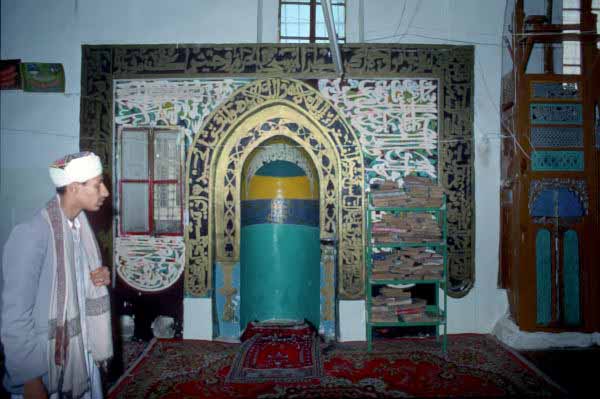
Musafariya mosque: Built in the 13th century, its white
is immaculate. The prayer room is covered by three
domes, that of the centre, on the top of the mihrab indicates the
direction of Mecca.
Ashraffiya mosque: Built at the foot of Jebel-Sabir, the
prayer room of is covered by eight small domes and a large one richly
decorated with calligraphies in reliefs and geometrical painted motifs.
Makhdabiya mosque: It looks like the former ones with
less domes on the top of the prayer room.
Jebel Sabir: The rise to Jebel was a very beautiful
excursion 3,070 m high.
The souq: As I often mentioned, it is a must. In Yemen, in the morning
they are very active in selling qat. It is possible to buy jambiya, the typical weapons
of Yemeni males. |
|
|
|
|
|
|
|
The mosque of the Rasulid time has a square plan and the prayer
room is covered by a terrace with domes, a central dome on the top
of the mihrab and on its sides in a square either one or four
domes.
The square with a cupola on top of it symbolizes the passage from the earth
to heaven, from concrete to abstract, from man to God. Islam, according
to the Byzantine "Iconoclast ",
prohibits figuration. On the other hand, calligraphy has acquired the
statute of major art as well as geometrical motifs. More
particularly, the volute, rolling up in spiral, symbolizes the rise
towards God like frankincense, and the notes of songs. Foliated scrolls
are decorated with volutes of flowers and vine. |
|
|
|
|
Aden |
|
|
|
|
|
|
Approach: Before reaching Aden, we visited an old-fashioned
market uncharacteristic Mahomet's land.
Souk-ad-Dabad: The site of ad-Dabad Wadi is located in the bed
of the brook and every Sunday a very picturesque market is held in Muslim land,
women are most active. They wear colour dresses and their yellow make-up,
containing curcuma and egg yolk, is both a protection against the sun and a way
to look smart.
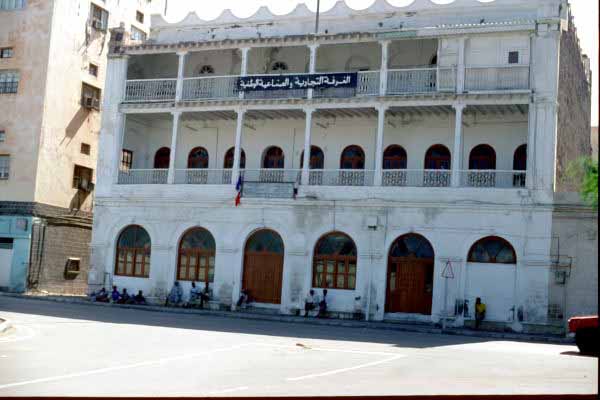
Aden: Aden, the former capital of the Democratic and Popular Republic
of Yemen, is a city built in a bay surrounded by extinct volcanos creating a harbour
site known since the earliest times.
The ethnological museum: It recalls the life of the populations through centuries.
It exhibits fabrics, silver artefacts and jambiyas.
Rimbaud's house: A building is presented as being Rimbaud's house,
there is no evidence. Franco-Yemeni official demonstrations took place to
commemorate the stay of the poet tending to attest the historical veracity.
Tawila: They were probably built at the Himyar time in the 1st century BC.
The sight over the crater and the old town of Aden is dramatic.
The crater: It is the old quarter of Aden. It gathers the
oldest monuments which have been left from the conflict of the years 1980's. |
|
|
The English were interested in this area of Africa as early as the beginning
of the 19th century. In 1799, they took possession of the Perim Islands
close to the Bab al-Mandab strait. In 1839, they conquered the city of Aden which
became a fortified city under the authority of the Viceroy of the empire of India.
The strategic interest of Aden lay in its maritime position on the road to India
and also in the artesian wells providing drinking water to supply His Gracious
Majesty's fleet. In 1854, the Kuria Muria Islands were occupied. From 1880 to
1914, a British protectorate was founded with local potentates to
neutralize the Ottoman claims. In 1905, a demarcation line was defined
between the belligerents, the "Violet Line". Great Britain was not concerned
in modernizing its protectorates. It controlled from Bombay. After the
independence of India, the things remained unchanged. Conflicts appeared
in years 60's. It was only in 1967 that the British became aware of the
situation and decided to retire from South Yemen. |
|
|
|
|
|
|
|
Bir Ali, Al Mukala |
|
|
|
|
Approach: This part of the journey took place in the former South Yemen.
When we made the trip the reunification of both Yemen was neither in facts nor
in mentalities. We took the coastal road to al-Mukala.
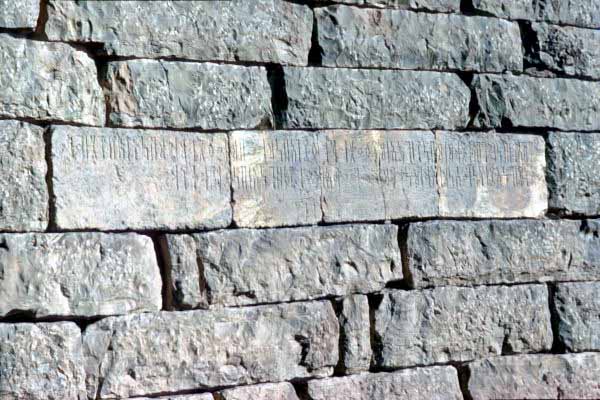
Naq al-Hajjar: Away from the coastal road and accessible by a
stony road from Azan, the antique city of Mayfa'a dates back to
before our era and knew its apogee in the 2nd and 3rd centuries. There
is still a very beautiful stone enclosure set up without mortar. In
the walls some stone blocks have inscriptions in South-Arabic, a preislamic writing.
Bir Ali: The city is an old harbour built on the site of former Qana.
The ruins of the citadel are on a volcanic rock, Hush al-Ghurab.
The city was the starting point of the frankincense road to Gaza which was
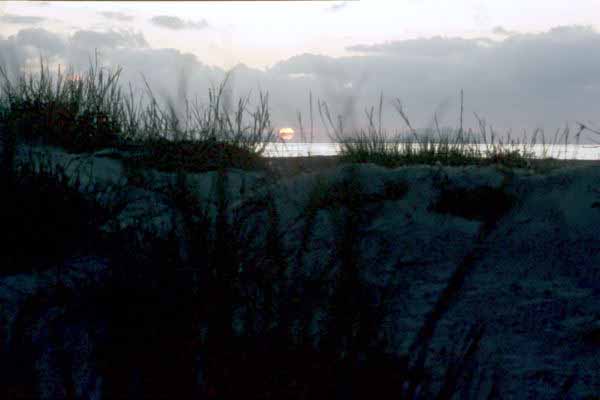
the harbour of the Nabatean kingdom. We arrived around 6 p.m. and set up
the bivouac on the seashore.
Al-Mukala: We took a sumptuous road on the seacoast to the fishing harbour of
al-Mukala. The site has been known since 1035 AD and its development was
continuous. The museum set up in a former palace exhibits artefacts from excavations
of the antique cities of Hadhramawt on the frankincense road from Dhofar, in Oman.
Khorayba: The valley of wadi Khuweiba is located in the Hadhramawt plateau,
it is a series of sterile entablatures dug out by water. The access track to the
village of Khorayba continued in the bed of the wadi covered by shingles polished
by the water streaming. We walked to the village to discover it on the
cliff sides dug out by the torrent for millions of years. It is composed, as
for North Yemen, of adobe multi-storey houses. This part of the trip took
place in the period of Ramadan making the night in funduq short and
noisy. The visit of the city in the early morning, at when the sun invades
the valley, was an unforgettable spectacle. |
|
|
|
|
The South-Arabic language, called Musnad, is written with an
alphabet probably invented in the first half of the first millennium BC.
Like many ancient writings, it is written in boustrophedon, from left
to right then from right-hand side to the left like the furrows of a field.
The South-Arabic language is a consonant Semitic language to which Himyar (Sabean),
Guèze and Amharique (Ethiopia) are connected. Arabic, Semitic language too, belongs
to the group of Aramean. |
|
|
|
|
|
|
|
The Hadhramawt valley |
|
|
|
|
|
|
Approach: The trip took a day to reach Shibam by the Hadhramawt valley in
the fog and with a sand wind reducing visibility.
Shibam: This antique city was the capital of Hadhramawt from the 3rd to the
16th century after the collapse of Sheba. Its very tight urban plan
consists of five or six-storey houses out of adobe and bricks
supported by wood elements on a stone base. The city is to be
discovered from a distance from the sand dunes to enjoy the city front which makes
it called the "Manhattan of the desert".
An astonishing spectacle, the cleaning of streets is made by goats
which graze all that they find, even plastic bags.
As we strolled through the city we saw the mosque, built in 904 by Arum al-Rashid,
and the 13th century citadel.
Sayun: It was the capital of the British protectorate. Constructions are
typical of the architecture of wadi Hadhramawt, half-adobe, half-bricks.
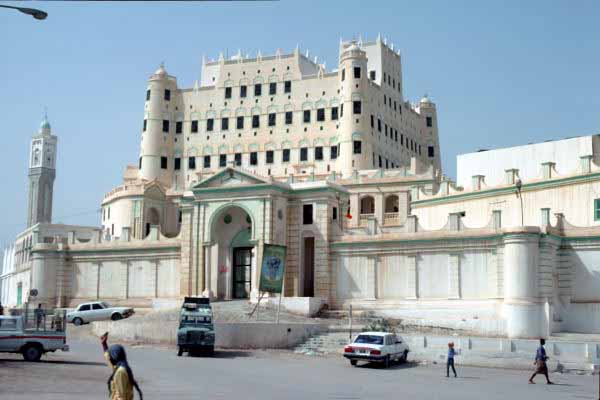
The museum is in sultan Kathiri palace, an enormous white building with window
frames painted in light blue. The artefacts exhibited come from the excavations
of the area. There are many potteries with drawings of ibexes and inscriptions in South-Arabic.
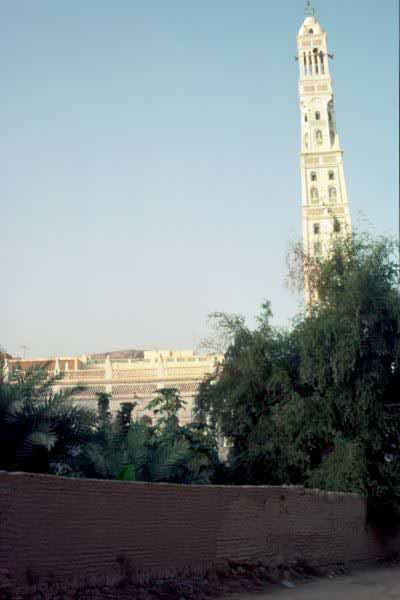
Tarim: The last of the three cities of Hadhramawt was the centre of the
Shafa'it school of Sunnite Islamic obedience. The city has several hundreds of
mosques, the official counting is 365! In fact, the city is
spiked with minarets. The architecture of the houses was subject to
South-Asian influences with the arrival of Hadhramit immigrants in
the 19th century. The minaret of the al-Muhdar mosque is 50 m high.
Shabaw: In the western part of the plateau, the city was the capital of Hadhramawt
before being supplanted by Shibam. The date of its foundation is
unknown, Pline is the first author of antiquity to mention a city
called "Sabota". Scattered ruins show inscriptions in
Thamoudean, a language of the North-Arabic group now extinct.
The night in bivouac was cold in the desert, the morning was misty,
the sun appeared white! |
|
|
|
|
|
The frankincense long road went up from Sheba to Gaza, the Nabatean
harbour. Sheba was the gathering place of goods coming from Dhofar,
in Oman, from the land of Punt, in Somalia, and the spices from Eastern
India. Caravans of almost one thousand camels took about sixty
days going from well to well.
The trilogy, gold, frankincense and myrrh of the Magi paying homage
to the child-king, got its aura of symbolism coming from the mists of time.
Gold is inalterable, incorruptible and is a particle of sun. Myrrh is
essential to the embalming of corpses, it is opposed to putrefaction and
gives immortality to the body. Frankincense in contact with purifying fire
rises in immaterial volute, escapes from stain and reaches forces which
govern the world and influence on the course of destiny.
Thus, the trilogy, gold, frankincense and myrrh is part of the search for eternity. |
|
|
|
|
|
|
|
Ma'rib, Baraqish |
|
|
|
|
Approach: The track to Ma'rib followed "the frankincense road"
between the desert and a mountainous plateau.
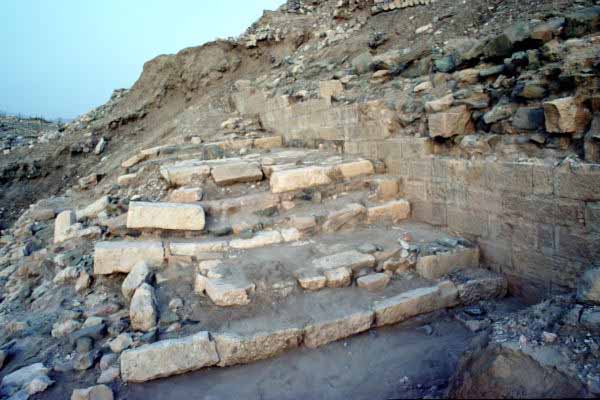
Timna: The city, today Hajjar Kuhla, was the capital of the Qateban
kingdom. The ancient site extends on more than 20 hectares of ruins
excavated in the fifties. As in all the area, multi-storey buildings were made of
adobe on stone bases. Only stone blocks are left of the old time splendour.
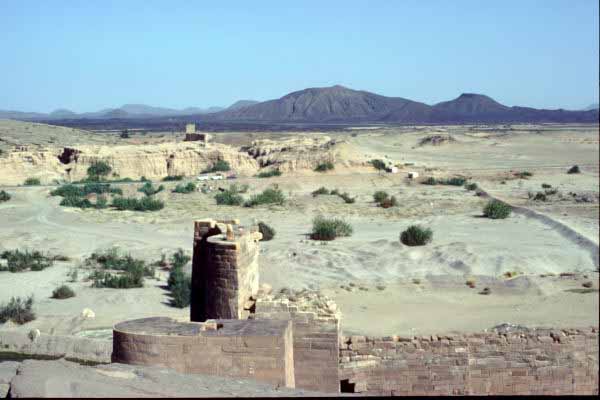
Ma'rib: The city, now silt up, was the capital of the
prestigious Sheba kingdom and its mythical queen.
Ma'rib dam: Only two sections of wall are left on both
sides of two mountainous ranges channelling wadi Adhana on 300m.
They are out of stones perfectly bonded with inscriptions which
made it possible to date the work. Its construction was made in
650 BC and the rupture of the dam in 570 BC was the decline of the kingdom.
Three hypotheses were put forth to explain this catastrophe. It is
possible that the conjugation of the three is the true explanation,
lack of maintenance, swelling of the wadi and finally seism. Close
to us such a catastrophe took place in the south of France!
The Arsh Balqis temple: Only five square columns can be seen
magnificently set up in the desert. No excavation had been
undertaken at the time of my visit.
The Awam temple: Its construction dates back to the 4th century
BC. In the interior of the enclosure a peristyle rises of 32 monolithic
rectangular columns announced by an alignment of eight large pillars.
Sirwah: The city on the bank of wadi Chada was the capital of
the Sheba kingdom until 8th century BC before the construction of Ma'rib.
The Belqis palace: It is majestic with a perfect round-off
in the east and two angle turns. Inscriptions of remarkable calligraphy
were carved in the stone blocks.
Baraqish: The city was the capital of the Minean kingdom founded
in the 4th century BC. It controlled the caravan tracks of South Arabia
from Dhofar (in Oman) and Hadhramawt. The inhabitants are said to have
domesticated the camel (actually the dromedary) to carry products, frankincense,
myrrh and spices.
The site has an impressive size, a crescent of 300m by 200m. |
|
|
|
|
|
|
|
The journey to Yemen was an immersion in sublime landscapes and the meeting of interesting
people. There, as in all the Middle East, prestigious antiquity is next to sordid present.
How and why this decline?
The reasons are probably complex, of economic as well as sociocultural origin.
Yemen, among the poorest countries suffers at least from two diseases:
Qat consumption from midday as a meal -Yemenis have ascetic figures -get men nonchalant
-unforeseeable at the wheel- and unfit for a concentrated work. A Yemeni day is
reduced to the morning.
Islamic faith in its requirements of prayer and its exclusions of
women makes economic development difficult if not improbable.
The prestigious past of this area was preislamic. Indeed, reality is
more subtle than this vision.
Drugs and faith turn man into a frightening warrior who comes to
swell the ranks of armies in search of something ambiguous. |
|
|
|
|
The return to France was made by Yemenia Airways flight with departure
in the morning and arrival in Paris in the afternoon. |
|
|
|
| Neuilly, le 2003/12/14 |
|
|
|
|
|
|