|
|
|
Turkey |
 |
|
Turkey, former Asia Minor, could be seen as the land's end
of Central Asia as shows the arrival of the Turks as early as 1071,
battles of Mantzikert. The conquerors from Europe or Asia left
prestigious vestiges. The future of this people, could be in Europe.
Western last stop of the Silk Road at the Antiochus harbour, Asia Minor
was the theatre of confronting between the Greek and Persian worlds.
The history of Turkey is not the topic of these pages. It is outlined
briefly to understand this country with a foothold in Europe.
Asia Minor was never a bridge between Europe and Asia. The physical
reality of the peninsula hardly lends itself to it. The geography of
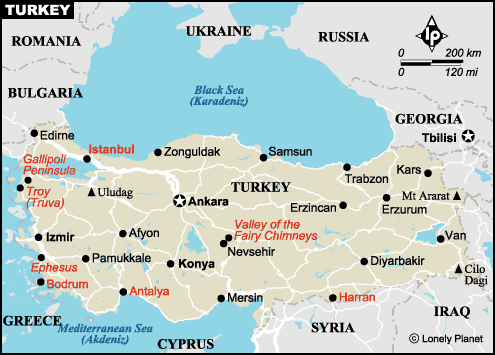
Turkey is presented in broad maps to locate the journey. |
|
|
|
|
|
History |
|
Geography |
|
|
|
|
Turkey is the place
where the first inhabitants of the Mediterranean region appeared
as early as 7500BC. Then, it was the cycle of the "empires".
The Stone Age (-3000BC): The first settlement of civilization
appeared at Catal Hüyük in the Neolithic and Chalcolithic eras.
The history of Turkey is presented in large periods.
The Bronze Age (3000-800BC) was characterized by the various
civilization levels of Troy. The Hittites founded the city of Hattusa
and were impressive at the time of the Qadesh battle against Ramses II.
The Persian period (700-323BC): Before Cyrus' conquests in
546 BC, the territory was occupied by Greeks, Phrygians and Lydians.
The Great Persian Kings took the country under their rules and structured
it in satrapies.
The Hellenistic period (323-131BC): Persians were booted out
not without resistance. The conquests of Alexander the Great were
not a simple military march.
The Roman period (130BC-331AD): Rome's intervention in the
area is the logical continuation of the defeat of the Macedonians at
the Magnesia battle. Rome set up the "province of Asia"
and "Pax Romana" was established.
The Byzantine period (330-1453): The triumph of Christianity,
the Barbarian invasions involved the collapse of Rome and the
foundation of the Eastern Roman Empire. "Roman Structures, Greek
culture and Christian faith: such are the great sources which gave
birth to Byzantium". Christic disputes, hazardous successions
caused of the collapse of empire under the attack of Arabs and other Turcomans.
The turquisation of the Byzantine empire started as of the 11th century
in Asia Minor with the Seldjukide victories and the foundation
of the sultanate of Rûm.
Ottoman Turkey (1453-1922), Bey Osman, the origin of the
dynasty's name, is regarded as the founder of the empire. The fall of
Constantinople by Mehmet II in 1453 really founded the empire. The
empire kept extending in the area until its decline announced
as early as 1789! The alliance with Germany at the time of World
War I, economic difficulties, the movement of the "Young Turks" and
the Independence War against Greece all led to the creation of the Republic,
in October 1923.
Republican Turkey (1923-): Mustapha Kemal was elected first
President of modern Turkey. The current challenge of Turkey consists of
its will to anchor itself to Europe. |
|
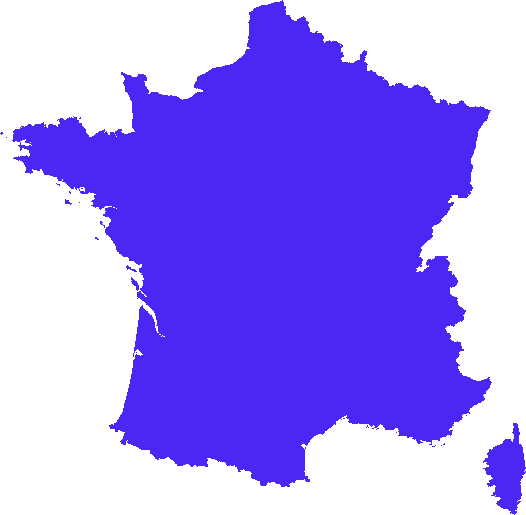
Turkey, former Asia Minor, has a rectangular shape, whose
surface is equal to 107% that of France.
It has borders with seven countries including five located on the
smaller sides of the rectangle, in the west in Europe, Greece and
Bulgaria, in the east in Asia, Georgia, Armenia and Iran, and two
countries on one of the longer sides in south-east, Iraq and Syria.
The longer sides of the rectangle are occupied in the north by the
Black Sea and in the south by the Mediterranean. The Aegean Sea shares
the west small side south-west of the rectangle. The distances are
large, from west to east 1,700km and 8,400km of coastline.
Turkey is a vast mountainous peninsula with a hard climate. It can
be presented in two sets:
The coast consists of three units. The "Pontic"
area in the north east on the Black Sea rises gradually eastwards
+4,000m high. The Mediterranean area, in the south, is made up either
of abrupt or of wide plains. Lastly, in the west the coast of the
Sea of Marmara, an inland sea between the Bosporus and Dardanelles,
and the coast of the Aegean Sea with a rough relief.
The interior is divided into four parts. Western Anatolia is
seldom below 900m high and rises 2,000m high in the east. Cappadocia
in the middle of the plateau is a volcanic area dug by water. Eastern
Anatolia is up to 3,000m high and culminates at the Ararat Mount 5,165m
high. The mounts of Taurus fringe the Mediterranean and the Syro-Iraqi
border and curve southwards forming Zagros, the border between Iraq and Iran.
Consequently on the climatic level, Turkey is characterized by three
large types of climates:
Mediterranean, the Aegean Sea and Mediterranean coast have a hot
and dry summer, mild and wet in winter.
The Anatolian plateau is cold in winter and hot in summer in the
western part and very hard and snow-covered in winter in the eastern part.
The septentrional coast is wet in all seasons.
|
|
|
|
|
Located between the 42° and the 36° parallels with a well watered climate,
Turkey has an abundant flora and rich species. Forests cover the northern
littoral of the Black Sea as well as that of the south of the Mediterranean.
Wild flowers splash the Anatolian plateau with all colours in spring.
Wild fauna is also abundant. It is of the Balkan type with bears, stags,
jackals etc. The Van cat with so particular fur and eyes is from Eastern Anatolia.
|
|
|
|
|
Economic facts |
|
Civilization |
|
|
|
|
Turkey's economy is contrasted,
there are two areas delimited by the Zonguldak-Gaziantep line.
The west is industrialized with a reproduction rate close to that of Europe,
the east is agricultural and poor.
Agriculture represents +40% of the working population. It is hindered
by a small farming surface, +7 ha. Breeding is still practiced by nomads.
Mineral resources are small there is iron in Anatolia and chromium
in Taurus, low in fuel minerals and hydrocarbons.
Industry is developed, employing 20% of the working population.
Thanks to the pipelines of the Middle East, Turkey has now a refining industry.
The equipping of the upper courses of the Tiger and Euphrates has made
Turkey the first producer of electricity in the area.
Trade is very weak. Turkey has a strong tourist potential.
The Turkish currency is the Turkish Lira (LT). |
|
The official name is Turkey whose capital is Ankara. The population
is +66 million inhabitants. The official language of Turkey is Turkish.
The population is 85% Turkish, the rest is Kurdish, Armenian, Jewish and
other Islamic population.
Turkey is a multi-party democratic republic.
Turks are 99% Sunnite Moslem, Jews, Christians. Islam has the same origin as
Judaism and Christianity. The faithful of these three religions belong to
the "people of the Book".
It is common to say that hospitality is the corner stone of Arab
culture. This tradition is the consequence of the hardness of life
in the desert and the habits of the Bedouin tribes who accommodate
strangers by offering them water, food and lodging.
The GNP is US$6,200 per capita. |
|
|
|
|
Mustapha Kemal, Atatürk, was determine to make his country modern, with
the giving up of the fez, the adoption of the Latin alphabet, the
phonetic transcription of the Turkish language, the secularization of
the constitution: "To Turquify, To modernize, to
westernize in order to relieve Turkey of its old demons".
But the political scene has changed. From the democracy controlled by Atatürk,
the country has passed to a multi-party system with excesses of the parties
to conquer power. The elections in 2003 showed it.
|
|
|
|
|
Travellers' information |
|
Sights |
|
|
|
|
Tourists from Western countries do not need visas, but valid passports to
remain up to three months.
On the health plan it is recommended to consult specialized websites, in
France the website of the Foreign Ministry. No particular precaution is
needed, it is necessary to be up to date with the usual vaccinations.
The budget of the traveller depends on his choices, Turkey offers
opportunities for small budgets. |
|
The geographical
situation of Turkey, its climatic variety offer travellers multiple possibilities of
activities by visiting archaeological sites as well as sports activities.
Sports activities are numerous in all areas
excursions, skiing, bicycling, diving and sailing on the Mediterranean coast.
In spring 1994, I made a journey in Turkey. |
|
|
|
| Neuilly, le 2003/12/21 |
|
|
|
|
|
|