|
|
|
Spain |
 |
|
Since the end of World War II
Spain Has been a privileged destination of all North Europeans looking
for sun and exoticism represented by bullfighting, flamenco and castanets.
But Spain has a very rich past and culture.
Our memory reduces the history of Spain to the
Arab occupation and to the conquistadors. It is outlined briefly to
try to understand its diversity.
The Iberian peninsula is the south-west land's end
of Europe and the western closing of the Mediterranean sea by the Straits of
Gibraltar -Djebel Al Tariq-, one of Hercules' columns.
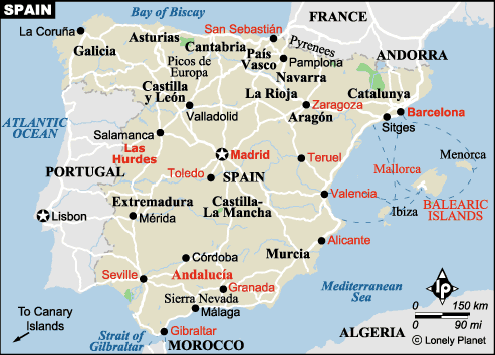
The geography of Spain is presented in broad maps to locate the journey. |
|
|
|
|
|
History |
|
Geography |
|
|
|
|
At the crossroads between
Europe and Africa -14 km separate the two continents-, Spain was often
coveted. Its history is presented in large phases:
Ancient Spain: Homo Sapiens left the mark of his passage in the
caves of Altamira, province of Santander. The Romans invested it in
the 3rd century BC and it took them two centuries to control it.
Visigothic Spain: In 411, the Barbarian invasions broke on all
Europe. In 419, a Visigothic kingdom was founded in the north of Spain.
Arab Spain: In 711, the Arabs crossed over the Straits of Gibraltar
and conquered the major part of the peninsula, except the north. They
occupied Spain for eight prosperous centuries. The territory was
called -Al Andalus- by the Spaniards. In 722, a battle against the
Visigoths marked the beginning of -the Reconquista- where the Arabs were defeated.
Monarchical Spain: In 1469, the union of the very Catholic
Isabelle de Castile and Ferdinand d'Aragon joined together the two kingdoms.
In 1478, the Inquisition became ruthless its methods against all
forms of heresy. Jews were executed and expelled -Sefarades- (Hebrew word
meaning Spain). From 1492, America's discovery by Christopher Columbus
brought sliver and gold from Mexico and Peru.
The same year, the fall of Grenade put an end to Al Andalus kingdom
and finished the Reconquista.
From 1830 to 1898, the events which occurred in the Americas caused
Spain to lose all its colonies.
Dictatorial Spain: The civil war from 1936 to 1939 whose
protagonists were the nationalists and the republicans, ended with the victory
of the latter. General Franco founded the dictatorship until his
death in 1975 and restored the monarchy.
Democratic Spain: The first free elections were organized in
1977. Spain entered the EU -European Union- in 1986.
In 1996, the elections gave power to the party of the conservatives
with Jose Maria Aznar. |
|
Spain is located in the Iberian Peninsula of quadrangular shape of
which it occupies 80%, the rest is Portugal on the Atlantic seashore.
Its surface is equal to 93% that of France. The average altitude of the
peninsula is 660 m high against 340 m high in France.
It has borders with France in the north - the range of the Pyrenees 430
km long and Portugal in the west.
Spain consists of a central plateau - Mesta-
structured in east-west longitudinal belts of ranges and valleys.
The Spanish geographical terminology is used in common international language.
It is presented in three large areas:
In the north: In the southern Pyrenees, the plateau is surmounted
by the Cantabrian Mountains in the back land of Asturias and Cantabrie and
cut by the Duero and Ebre valleys.
In the centre: The plateau is raised by the Iberian mounts, the
Gata, Gredos and Guadarrama Sierras and cut by the Tage and Guadiarra valleys.
In the south: The edge of the plateau is structured by the Sierra Morena
and the Bétiques ranges and cut by the Guadalquivir valley.
The highest point of the peninsula -Mulhacén 3,478 m high- is located
in the Sierra Nevada.
South Spain -Estrémadure and Mancha- is the hottest area
of the peninsula: Madrid is at the latitude of Naples and Istanbul.
Consequently on the climatic level, it is preferable
to visit Spain:
-The north : in summer.
-The centre : in spring.
-The south: in winter.
|
|
|
|
|
The vegetation of Spain, green in the north, is composed of oaks, beeches and
broom moors.
The Mediterranean area is wooded with holm oak and pine. Spain,
burnt in the south, is the land of palm tree and Alfa grass as in the Maghreb.
The Fauna is the mild climate type in the north, fox and wild boar. The
Mediterranean area is the habitat of partridges, ducks and quails.
|
|
|
|
|
Economic facts |
|
Civilization |
|
|
|
|
Spain's economy took off in the years 1960's:
Since then the GDP has quadrupled. This development was accompanied by the
modernization of social structures which is still short of European standards.
Agriculture is 4.25% of the GDP employing 7.1%
of the working population. It exports mainly citrus fruits, olives, tomatoes
and wines. It has the first vineyard in the world in surface. It is a major
actor of halieutic industry:
The first producer in Europe before Denmark and France.
Mineral resources are important: lead,
copper, mercury and iron. Coal mines in Asturias and lignite in
Catalonia provide a part of power. It is a hydrocarbon importer.
Industry is advanced, 17.6% of the GDP
employing 31.2% of the working population. Basic industries,
steel-works, metallurgy, petrochemistry and process industries
are very dynamic since the integration in Europe.
Trade is important with the EU. The exchanges
with Latin America are only 6.2% of the GDP. Tourism is a traditional activity
due to the artistic heritage and the geographical location in Europe.
The GNP is US$21.200 per capita.
The Spanish currency is Euro (€). |
|
The official name is
Kingdom of Spain whose capital is Madrid. The population is +40
million inhabitants. The official language of Spain is Spanish
but Castilian, Catalan, Basque, Galician are also spoken.
Spain is a parliamentary monarchy founded by the
constitution which came into effect on December 29, 1978. The king, Juan
Carlos, Head of the State, was a decisive actor in the introduction of
the democracy and the keeping of social cohesion. The legislative
power is exerted by the "Cortes Generales" composed of two houses.
The Spaniards are 99% Catholics but only 40% are
regular churchgoers.
Spain has a great artistic and cultural
legacy:
- Painting is one of the favourite fields of Iberian artistic
expression. The great figures are: El Greco, Vélasquez,
Goya, Miro, Picasso, Dali...
- In literature: Cervantès, Lorca... stand out
- Cinema was a long time influenced by Buñuel's surrealism and more
recently by Almodovar.
At the Crossroads of civilizations, Spain has vestiges
which are as many architectural references.
- Ancient Rome left ruins at Tarragona.
- The Umayyad built the jewels of Grenada and Cordoba.
- Very Catholic Spain built Gothic cathedrals and sumptuous palaces.
The art of bullfighting is part of Spanish culture and traditions. |
|
|
|
|
Like all countries, modern Spain is the result of the civilization
movements which shaped it for millennia. The extrovert temperament
and the Spanish proud bearing are certainly related to the southern situation
of the peninsula. But the sun does not explain every thing: The Romans, the
Visigoths, the Moors, all left their prints as far as in the pronunciation
of the words from Latin origin which were corrupted by Arab pronunciation.
|
|
|
|
|
Traveller's information |
|
Sights |
|
|
|
|
Tourists from
Western countries do not need visa to enter Spain. For a stay beyond
90 days, they must obtain a visa. Citizens from the EU "Schengen Convention"
can move freely.
On the health plan it is recommended to consult specialized websites, in
France the website of the Foreign Ministry. No particular precaution is
needed, it is necessary to be up to date with one's usual vaccinations.
The budget of the traveller depends on his
choices, Spain offers opportunities for small budgets. |
|
The geographical
situation of Spain, its climatic variety offer travellers
multiple possibilities of activities in archaeological sites
as well as on the Atlantic Ocean and Mediterranean coasts and in the
Balearic and the Canary Islands.
Sports activities are possible in all areas
of Spain, excursions, climbing, cycling, deep-sea fishing,
diving and surfing on coasts.
I made an individual stay in Spain in July 1971. |
|
|
|
| Neuilly, le 2004/03/07 |
|
|
|
|
|
|