|
|
|
Mexico |
 |
|
Mexico attracts all tourists, art lovers, sportsmen and
lovers of beautiful beaches.
The many archaeological vestiges are the main attractions:
The gigantic Olmec heads are in all memories. The country of
the "Feathered Serpent" is a link between the two Americas.
The eventful history of Mexico is not the topic
of these pages. It is outlined briefly to understand the three cultures.
Although being in the central part connecting the two
Americas, Mexico is attached geographically to North America. The
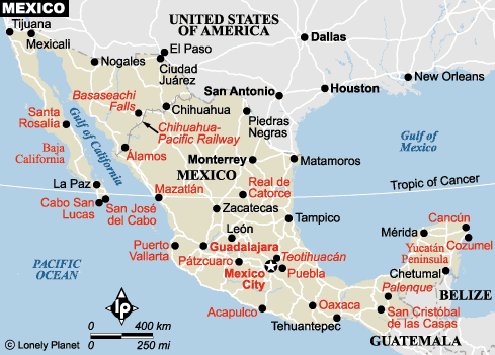
geography of Mexico is presented in broad maps to locate the journey. |
|
|
|
|
|
History |
|
Geography |
|
|
|
|
The history of Mexico is
presented in great phases.
Precolombian Mexico: The excavations have attested the emergence of Olmec
civilization in 1200BC.
From 250 to 900 AD, the Teotihuacán and Maya civilizations developed,
the former in the north of Mexico City and the latter in the peninsula
of Yucatan divided between Mexico, Belize, Guatemala, Honduras and El
Salvador.
From 900 to 1200, the Toltec civilization replaced the former two and set
its capital at Tula in the north. Hordes of Looters destroyed it.
From 1200, the Aztec civilization appeared and gradually extended its
power on the area.
Colonized Mexico: After Christopher Columbus' discovery, the
conquistadores landed in 1519 with Cortès at their head Cortès'
political sense subjugated emperor Moctezuma who recognized
Quetzalcóatl in him.
In 1520, after the assassination of the emperor, the town of
Tenochtitlan was destroyed. Mexico City was built on its site.
From 1524, the Spaniards civilized and evangelized the Indians. The
population decreased from twenty-five to one million inhabitants!
In 1810, the revolt of the Criollos, people born of Spanish parents, launched
the process of independence.
Independent Mexico: The republic was proclaimed in 1823 after
viceroy Iturbide had changed camps.
In 1846, the war with the USA ended with the joining of six provinces
to the USA.
In 1863, a French task force seized Mexico City. The Legionaries
won fame at the battle of Cameron, only two of them were left!
From 1920 to 1999, the PRI, Institutional revolutionary Party, reigned
without division.
Mexico, Multi-party Democracy: In 2000 the presidential election
of Vicente Fox opened a new era. In 2003, the NAFTA came into effect. |
|
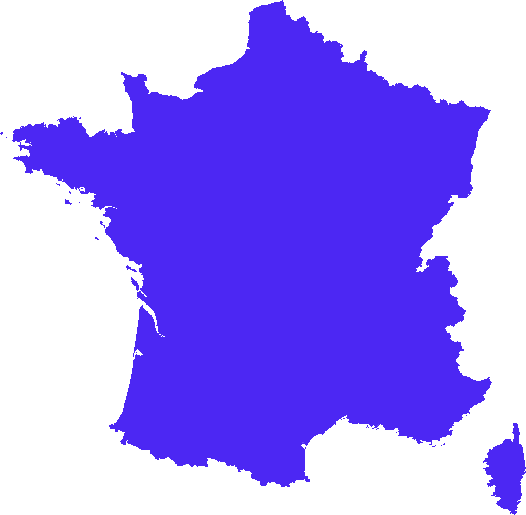
Mexico has the shape of a grave accent, whose surface is equal
to +3 times that of France.
It has borders with the USA in the north - +3,000Km - and Guatemala and
Belize in the south.
It is presented in three great areas:
In the north, the two coastal plains are bordered
by two ranges, the Eastern Sierra Madre and the Western Sierra Madre.
They border a vast plateau - the Altiplano Central- located between
1,000 and +2,000m high.
In the southern centre of Mexico City, the Sierra Madre del Sur
borders the Pacific coast with active volcanos including the two
main ones: Pico de Orizaba (5,611 m) and Popocatépetl (5,452 m).
In the south, the narrow part of Mexico consists of lowlands and
plateaus. The peninsula of Yucatan curves in the Gulf of Mexico, the
Caribbean Sea. The Sierra Madre de Chiapas borders the Pacific Ocean.
Located on the belt of the deserts of the planet, Mexico
does not have a true desert although 71% of the area receive little precipitations.
Consequently on the climatic level, Mexico, crossed
by the tropic of Cancer, is characterized by three main types of
climates according to altitude:
-Lower than 800m : warm.
-Between 800 and 1,600m: the mild zone.
-Higher than 1,600m: cold earth.
In summer, the trade winds bring humidity. In autumn
and winter the cold masses from the Far North bring dry air.
It can freeze in Vera Cruz. |
|
|
|
|
Apart from the little watered areas of the "Altiplano Central", Mexico
has varied vegetation represented by oak and pines. The southern part, the peninsula
of Yucatan, has vegetation of the humid tropical type, ferns, mahogany trees and palm trees.
Extensive breeding in the north has partly destroyed large mammals:
pumas, deer and coyotes. The tropical forest is the habitat of monkeys,
tapirs and reptiles. All categories of birds are represented.
|
|
|
|
|
Economic facts |
|
Civilisation |
|
|
|
|
Mexico's economy is
well developed. The agreement of North-American Free Trade -NAFTA-,
its diversified industry and enormous mineral resources are major advantages.
Agriculture represents 4,3% of the GDP. The
problem of the distribution of the lands is endemic due to inequality
of the geological composition and the demographic settlement.
The variety of the climates allows the cultures of coffee, cocoa,
citrus fruits, and bananas, all productions related to the world trade.
Mexico become a major actor of halieutic industry.
Mineral resources are appreciable. Oil
and ferrous and nonferrous ores are at the origin of the industrial,
commercial development and transportation.
Industry is advanced, 28% of the GDP
employing 23% of the working people. Basic industries, steel-works,
metallurgy, petrochemistry and processing industries are very
dynamic.
Trade is important and centred on North
and Central America. Tourism is a traditional activity due to
the richness of the artistic heritage.
The GNP is USS9,1500 per capita.
The Mexican currency is Peso. |
|
The official name is
Estados Unidos Mexicanos whose capital is Mexico City. The
population is +100 million inhabitants. The official language of Mexico
is Spanish as well as around fifty Indian languages.
The population is mostly Mestizos - Spanish and
Indian origin and a Indigena minority - Nahuas, Maya,
Zapotecs, Mixtecs, Totonacs and Tarascos.
Mexico, a Federal State, is a democratic and
multi-party republic. Two representative chambers share the
legislative power. The president is elected for six years.
Mexicans are 90% Catholics and 6%
Protestants, with a connotation of animism for some Indians.
Summarizing Mesoamerican civilizations is a
challenge. According to the Plaza of the Three-Cultures, it is
necessary to consider Precolombian, Hispanic -colonial-
and modern -Mexican- civilizations.
Precolombian civilization is equal to great Egyptian and Greek civilizations.
Although it is heterogeneous, it has constant features: corn, for food, hieroglyphs
for the writing, astronomy for the lunar and solar calendars.
The Hispanic civilization is primarily religious and the pictorial art was influenced by
Spanish art.
The Mexican civilization is a synthesis which appears in architecture,
mural art and literature. |
|
|
|
|
Being a synthesis, the Mexican civilization is original according to
the principle of synergy. The Mexican language is not Castilian.
The contributions of around fifty Indian languages enrich it with many
"Mexicanisms". Modern literature is represented by some famous
names such as Octavio Paz. Popular music is represented by the "Mariachis".
Mexico is a paradise for amateurs of human contacts.
|
|
|
|
|
Traveller's information |
|
Sights |
|
|
|
|
Tourists of
Western countries do not need visas to enter Mexico. For a stay
higher than 72 hours, they must obtain a 180-day tourist card at the
border or at embassies.
On the health plan it is recommended to consult
specialized websites, in France the website of the Foreign Office.
No particular precaution is needed, it is necessary to be up to date
with one's usual vaccinations.
The budget of the traveller depends on his choices,
Mexico offers opportunities for small budgets. |
|
The geographical
situation of Mexico, its climatic variety offer travellers
multiple possibilities of activities in archaeological sites
as well as on the coasts of the Atlantic Ocean and the Pacific Ocean.
Sports activities are possible in all areas of Mexico,
excursions, expeditions, bicycling, high-sea fishing, snorkelling and diving,
windsurfing and surfing on the coasts.
I made an individual journey to Mexico in August 1984. |
|
|
|
| Neuilly, le 2004/02/29 |
|
|
|
|
|
|