|
|
|
Hungary |
 |
|
Hungary is wedged in Danubian Central Europe in contact with
the Germanic, Slavic and Latin worlds. The Magyars, out of the Indo-European
sphere, from time immemorial have developed their originality including their
successful liberalization after soviets regime.
On the invasion road from the east and the south,
Hungary was occupied by the Ottomans. Its history is outlined briefly
to try to understand its originality.
The area occupied by Hungary has no natural border
and yet it has existed in the Danubian plain since the 8th century.
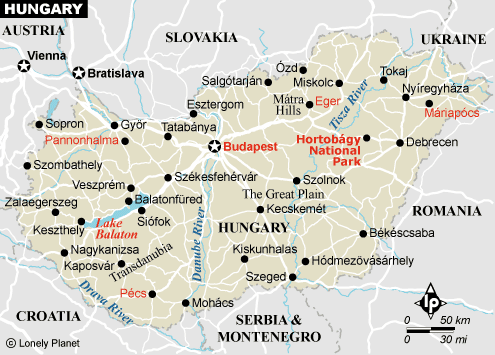
The geography of Hungary is presented in broad maps to locate the trip. |
|
|
|
|
|
History |
|
Geography |
|
|
|
|
In the centre of Europe,
Hungary has been crossed -from time immemorial- by invaders from the east
and the south : the Scythians, the Celts and the Romans.
Archaeological sites show these prehistoric settlements in particular
at Obuda. Its history is presented in large phases:
Magyar Hungary: In 750 AD, the Magyars succeeded the invaders.
Their expansion was stopped by Germanic Otton Ist at the battle of Augsburg.
The kingdom of Hungary: In the year 1000, Magyar prince Etienne
Ist became the first Christian king. From 1038 to 1301, the Arpad dynasty
kept the power, but dynastic competitions destabilized the kingdom.
From 1301 to 1490, Hungary under the reign of Charles and especially of
Matthias Corvin became a European power turned towards the West.
Arab Hungary: In 1526, the Arabs were victorious at the battle
of Mohacs and settled in the country.
The Austro-Hungarian empire: In 1699, the Austrians drove out
the Ottomans. They annexed Hungary.
Emancipated Hungary: In 1849, Lojas Kossuth proclaimed the
independence which was repressed harshly by the Austrians. In 1867,
Austria, weakened, conceded double monarchy: Austrian and Hungarian.
Misled Hungary: Austria having made the bad choice during the
First World War was dissolved in 1918. The Republic of Hungary was
proclaimed in 1918. Its borders were defined by the Treaty of Trianon
in 1920.
In 1940, Hungary made the same bad choice as Austria in 1914. From 1944
to 1945, the Red Army occupied the country. In 1947, the Treaty of
Paris gave back the borders of Trianon.
Communist Hungary: From 1947 to 1989, Hungary was included in
Eastern European countries with the events of 1956.
Democratic Hungary: In 1989, the first free elections were
organized. In 1999, the country joined NATO. In 2002, it joined
the European Union.
Hungary will enter the EU in May 2004. |
|
Hungary is wedged in the centre of Europe. It has kidney-shaped.
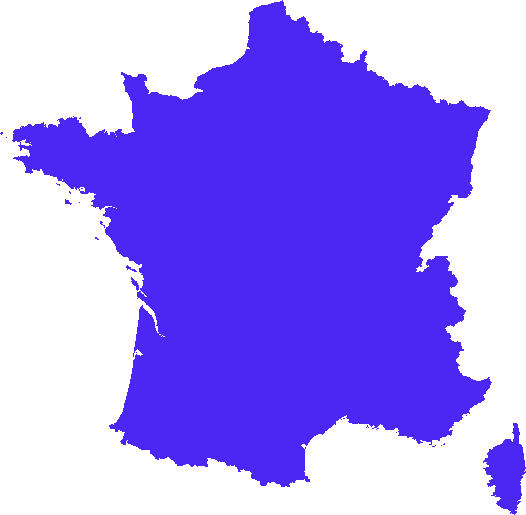
Its surface is equal to 17% that of France.
It has borders with Austria, Slovakia and Ukraine in the north, Romania
in the east, Serbia Montenegro in the south and, Croatia and Slovenia in
the west.
Hungary has no natural border except with Croatia,
the Drava river. Two thirds of the country have an altitude lower than
200 m. It is crossed by the Danube in the west and the Tisza in the
east which cut it out in three parts from north to south.
Consequently, it is a flat land with +1,000 lakes among which lake Balaton.
It is presented in three large areas:
In the centre, east and south east:
The Great Plain extends on both sides from the Tisza river.
In the north west: The Small Plain constitutes the western gate
of Hungary beyond the Danube.
South west, North east: The ridge of mounts, Bakony,
Matra and Bükk culminates at Kékestoto 1,015 m high. The Danube runs
between mounts Bakony and mounts Matra in the north of Budapest.
The Danube divides the country into Transdanubia in
the west and Cisdanubia in the east. The Tisza runs across the central
plain in many meanders. The hydrography of Hungary holds it under the
threat of floods.
Consequently, the temperate climate can be divided into:
Mediterranean in the south, Continental in the east and Atlantic in the west.
-the summer is hot and very sunny, 28°C.
-the winter is hard with wind and snow, -2°C. |
|
|
|
|
Vegetation of the herbaceous type in the plains is preserved in
the national park of Hotobagy. Forests, 14% of the surface, are made
up of oaks and beeches in the mountains and birches in the plains.
Fauna is of temperate type with deer and wild boar. The
abundance of birds has developed the activity of bird-watching.
|
|
|
|
|
Economic facts |
|
Civilization |
|
|
|
|
Hungary's economy
has undergone a "shock therapy" since 1990: privatization
of the property of the socialist State and development of the market economy.
Agriculture has constituted, for centuries,
the power of Hungary due to its geological, hydrographical and climatic
configuration: 90% of the land is cultivable with cereals, oilseeds
and beets. The vineyard is important and the Tokay vintage is famous.
Breeding concentrates on poultry, pigs and bovines.
Mineral resources are not very important:
bauxite, manganese and uranium. The production of coal, gas and oil
are not enough for internal consumption.
Industry was concentrated on iron and steel
industry during the communist period. The plan of the years 1990 developed
the Budapest-Székesfehérvar-Györ triangle with mechanical engineering
and electronic industries. Foreign investments are considerable:
German investors own +30% of the industry.
Services have also bee privatized:
banks and insurances are the most privatized of Eastern European countries.
Trade was reoriented from Eastern European
countries to European Union countries in order to absorb the shock
of the "therapy of privatization" and the reduction of the social
security of the State.
The GNP is US$13,300 per capita.
The Hungarian currency is the Forint. |
|
The official name is
Republic of Hungary whose capital is Budapest. The population
is +10 million inhabitants. It is 90% Hungarians, 4% Gypsy,
3% Germans and the rest are Slovaks and Rumanians. The official
language is Hungarian as well as German.
Hungary is a parliamentary republic founded by the
constitution of 1989. The Parliament with only one chamber is elected for
four years. It nominates the Chief of the State, for five years, and the
Chief of the Government.
Hungarians are 68% Roman Catholics, 21% Calvinist
Protestants, 6% Lutheran Protestants and Others.
The specificity of the Hungarian language has strongly
influenced the Magyar civilization. It does not belong to the Indo-European
group but to the Finno-Ugric group of the agglutinant and monotonous type.
This linguistic particularism ensures social cohesion with the one-third
of Hungarians living abroad.
Literature has been developed late, its blossoming dates
from the 19th century with poetry, and the lyric romanticism of nationalists.
The Roman and Gothic churches of the beginning of
Christianity were ransacked by the Ottomans then rebuilt in the
baroque style.
Classical music is represented by universally
famous composers: Liszt, Kodaly, Ligeti.
Cinema largely takes part in the diffusion of
the Magyar culture. |
|
|
|
|
Hungary is a model in Eastern
European countries. Its economic success, not without social clashes,
is an example to be followed: but doesn't it arise from the
Magyar specificity? Social recomposition has been in process since 1990's,
of course social inequalities are growing. The liberal education
system has a role in the revival of the elites.
|
|
|
|
|
Traveller's information |
|
Sights |
|
|
|
|
Europeans do not need
visa to enter Hungary. Tourists from the other countries must have
a visa valid for a stay from 30 to 90 days.
On the health plan it is recommended to consult
specialized Internet sites, in France the site of the Ministry of
Foreign Affairs. No particular precaution is needed, it is necessary
to be up to date with one's usual vaccinations.
The budget of the traveller depends on his
choices, Hungary offers opportunities for small budgets. |
|
The geographical
situation of Hungary, its climatic variety offer travellers
multiple possibilities of activities.
Hungary does not have a seashore
Sports activities are possible in all areas of Hungary,
excursions, caving, bicycling, canoeing on the Tisza river, flying
on ultra-light aircraft over lake Balaton and windsurfing on its water.
I spent the end of the year 1979 and the beginning of
1980 in Budapest. |
|
|
|
| Neuilly, le 2004/03/07 |
|
|
|
|
|
|