|
|
|
Scotland |
 |
|
Scotland belongs to the United Kingdom with England, Wales and
subsidiarily Ulster and a multitude of islands gathered in archipelagos.
.
The former settlement of Picts, the arrival of the
Celts generated Scots by crossbreeding. The history of Scotland is
not the topic of these pages. It is outlined briefly to try to
understand the particularisms of it.
The savage temperament of the Scot is closely
related to the geographical situation of the country near the
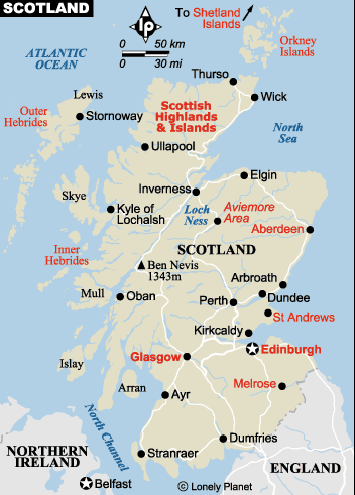
Arctic circle. The geography of Scotland is presented in broad maps
to locate the journey.
|
|
|
|
|
|
History |
|
Geography |
|
|
|
|
The history of Scotland
is presented in large stages.
Scotland: As of 4000 BC, the settlement of the area by hordes
from England is attested. Then in 800 BC, Celts coming from Europe
settled there.
Scotland and Rome: The Romans fought against the vindictive Picts.
Hadrian built a "wall of protection" against the barbarians in 122 AD.
Scotland Christianized: After England and Wales, the Catholic
evangelization reached Scotland.
The Scotland of the rival fiefdoms (6th-9th century): A Celtic
tribe, the Scots, settled in the lowlands followed by Anglo-Saxons.
The various Viking invasions cemented the unification.
In 843, Scot king Kenneth Mac Alpin founded the kingdom of Scone,
unifying Picts and Scots.
Anglo-Saxon domination: In 1296, Edward I annexed Scotland.
As in Wales and in Ireland, he colonized the country.
From the 13th to the 15th century, the Scottish rebellion imposed severe
defeats on English armies. It was helped by its alliance with France was in relation.
In 1603 when Queen Elizabeth I died, Jacques VI of Scotland became
Jacques I of England.
In 1707, the Act of Union was signed between the two countries.
Industrial Scotland: The industrial revolution and the
development of Protestantism supported intellectual flowering. But the
famine in 1840 caused an important emigration to English colonies.
Autonomous Scotland: In 1967, the Scottish national Party (SNP)
obtained its first seat in the British Parliament. The discovery of oil
in the
North Sea and its seizure English companies reinforced nationalism.
Finally in 1999, Scotland obtained an autonomous Parliament in Edinburgh. |
|
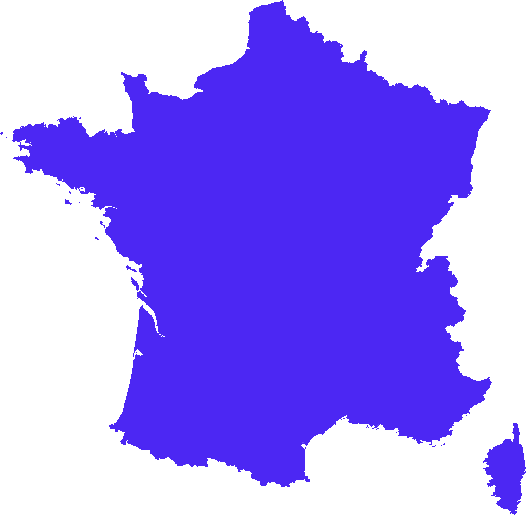
Scotland covers 34% the United Kingdom and its surface is equal to 14% that of France.
It has border with England in the south. The border approximately follows the
Hadrian's Wall built in the 2nd century by the Romans. It is the median
line of the three political divisions of the British Isles.
Scotland can be presented in three areas:
In the south, the uplands consist of fertile plains
and hills bordering England.
In the centre, the lowlands stretch from Edinburgh to Glasgow and
are the industrial belt of Scotland with the densest population.
In the north, the highlands are the highest mountains in the United Kingdom.
The Grampians mounts culminate at Ben Nevis 1,343m high.
The West coast is indented by many fjords.
On the climatic level, Scotland is characterized by
a "changeable" climate. The space-time variations can be very large :
In the day and from an area to an other.
The West coast influenced by the Gulf Stream is milder and wetter than the
East coast, cold and dry.
The summer months, July and August, are the hottest.
The spring months, May and June, are the driest.
In the north of Scotland, the sun barely sets in summer and it
barely rises in winter. |
|
|
|
|
Hadrian's Wall was built in 122 AD, it marked the northern border
of the Roman Empire. From east to west, from the North Sea to the Irish
Sea, from Wallsend-on-Tyne to Bowness-on-Solway via Carlisle, the
wall crosses wild landscapes on 73 miles. Registered in the World
Inheritance, the path of Hadrian's Wall open in 2003.
As in England and in Wales, the forest disappeared to less than 1% of the
area with nothing more than heather moors and peat bogs.
|
|
|
|
|
Economic facts |
|
Civilisation |
|
|
|
|
The agricultural and
industrial revolution at the end of the 18th century made Britain
the first industrialized country in the world for one century.
Now it is an example of a post-industrial economy, a model for all
the countries in continental Europe.
Agriculture is 1,2% of the GDP with
2% of the working population. Three quarters of the lands are
exploited by the owners. Three quarters of the lands are devoted
to breeding. Cultivated lands are centred on cereals.
Fishing has become marginal. Forest is the most reduced in Europe.
Mineral resources: Coal does not play any
more the part of economy mover. It was replaced by oil and gas that
England exports. The production of electricity power comes equally from nuclear power, gas and coal/oil.
Industry is well developed, 18,8% of the GDP
employing 14,7% of the working population. The action of the State was
decisive in the reorganization of the sector causing the Midlands
to decline. Industry is multinational and sometimes without British
capital: i.e. the automobile sector.
Services is 70% of the GDP and 75% of the
working population. Tourism is very developed.
The Scottish currency is the pound sterling (£). |
|
The official name is
Scotland whose capital is Edinburgh. The population is +5
million inhabitants. The official language of Scotland is Gaelic
and English. The population is to 90% Celt, the rest is Anglo-Saxon.
Scotland is a parliamentary democracy. The Head of
the State is Queen Elizabeth II. It is a member of the European Union.
The Scots are Presbyterian, Anglican and Catholic.
Two symbols characterize arts and Scottish
traditions:
- The Bagpipe is unquestionably the emblematic music instrument of Scotland.
- The Tartan is of Roman origin. It marked the belonging to a clan as from
the 17th century.
The Scottish language is Gaelic, it is declining in
spite of the action of the authorities. However expressions pepper
daily English making it not easily understandable.
The GNP is US$18,000 per capita. |
|
|
|
|
The geographical and geological roughness, the hard climatic of
this area on the borders of the Arctic have shaped the character of the
descendants of the Celts.
"Pub conversations" are about sporting events opposing Protestants and Catholics or on Scottish
nationalism and the appropriation of oil by the English.
|
|
|
|
|
Traveller's information |
|
Sights |
|
|
|
|
Tourists of Western countries do not need visas to enter
Scotland, just a valid passport to stay up to six months.
Nationals of the European Union may live and work there freely.
On the health plan it is recommended to consult specialized websites, in
France the website of the Ministry of Foreign Affairs. No particular precaution is
required, it is necessary to be up to date with one's usual vaccinations.
The budget of the traveller depends on his choices,
Scotland offers opportunities for small budgets. |
|
The geographical
situation of Scotland, its climatic variety offer travellers multiple
possibilities of activities in the archaeological sites as well as in the mountains.
Sports activities are possible in all areas,
excursions, cycling, golf, river fishing and birdwatching on the West coast.
I made a trip to Scotland in August 1979. |
|
|
|
| Neuilly, le 2004/01/31 |
|
|
|
|
|
|