|
|
|
England |
 |
|
England belongs to the United Kingdom with Wales, Scotland and
subsidiarily Ulster and a multitude of islands gathered in archipelagos.
The United Kingdom is the oldest democracy in the modern world with a
political organization without equal. It could be defined as a constitutional monarchy.
The settlement of the area started before the
flooding of the strait of Dover at the end of the last ice age. The
history of England is not the topic of these pages. It is outlined
briefly to try to understand the particularisms of it.
It is common to define the English character by
its geographical situation, insularity. However the United Kingdom
is a recent island, indeed the separation from the European continent
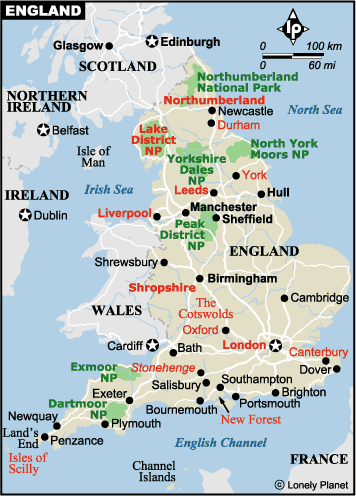
dates back to 6000 BC. The geography of England is presented in broad
maps to locate the journey.
|
|
|
|
|
|
History |
|
Geography |
|
|
|
|
The history of England
is presented in large stages.
Ancient England: As of 6000 BC, small troops of hunters
are attested. From 4000 BC, people built the monumental sets of
Stonehenge and Aveburg. In 800 BC, the Celts coming from the centre of
Europe settled in the country.
Roman England (43AD-410): Rome invaded all England, except Wales
and Scotland. Rome left the Great-Island which brought more problems
than advantages.
England of the rival fiefdoms (6th-9th century): The area set
free after the departure of the Romans was settled set by
tribes, the Angles and the Saxons. In the 9th century, the Vikings,
Norwegians and Danes, settled in Scotland and progressed
southwards. Only Wessec - the half-Saxon and half-Celtic - remained
under English control.
Norman England: In 1066 after the battle of Hasting, William the
Conqueror ruled the country and imposed the French language. The assimilation
of cultures Anglo-Saxon and Norman culture was done gradually. The following
centuries were marked by the Hundred Year War between England and France.
Unstable England (16th-17th century): Henri VIII, due to his
matrimonial problems, broke with the Vatican and proclaimed himself head of
the Catholic church: the Anglican Church was born. The dispossession of Catholics
followed and more particularly in Ireland. Cromwell took advantage of the Civil War
but finally the monarchy was restored in 1660: The constitutional monarchy was born.
The colonial expansion developed in North America, in Canada, in India and Australia.
Industrial England: The industrial revolution emerged thanks to
the entrepreneurship and presence of natural resources. Queen Victoria
had a decisive influence on the development process. The two World Wars
had significant effects on the evolution of England. The main result
was the loss of the colonies after 1947.
The revival of England: Incontestably, Margaret Thatcher can be
credited for placing England back in the top European countries. |
|
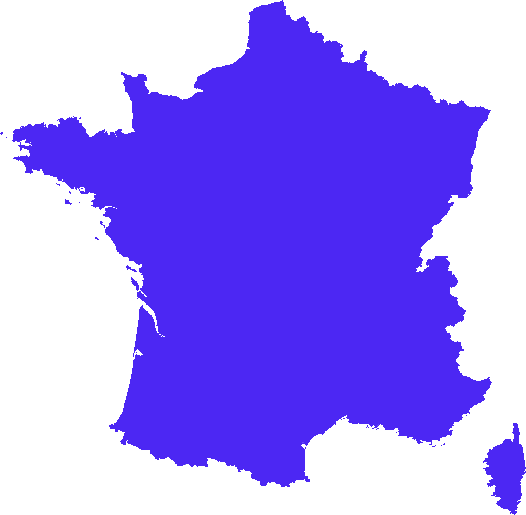
England covers 57% of the United Kingdom and its surface is equal
to 24% that of France. Consequently, the density of population is
twice that of France.
It bound by Scotland in the north and Wales in the west. It is the
largest of the three political divisions of the British Isles.
The United Kingdom stretches on 1,000Km from north to
south and on 600Km from east to west. The smallest distance from east
to west is 75 km in Lancashire and Yorkshire. No point in England is
more than 120Km away from the sea.
England can be presented in four areas:
In the north, the Pennines a limestone chain
240 km long, from the Tyne to the Trent. The highest summits are
Croos Fell (893 m) and High Peak (636 m).
In the west, the Cumbrian mountains culminate at Scrawfell 978 m high.
The Lake District is the area of the romantic poets with its cascades, its mist
and its moors.
In the centre and the east, the lowlands constitute the
Midlands, the large agricultural and industrial areas.
In the south-west, the granite plateau is the Cornwall peninsula
and its rugged coastline.
Consequently on the climatic level, England is
characterized by a mild climate of oceanic type, mild and wet:
Cloudy sky and light drizzle everywhere and at any time.
The temperature
variations are small and rainfall is hardly lower than 600 mm.
The summer months, July and August, are pleasant
with an average temperature 20°C.
The winter months, from December to February, are particularly mild, it
seldom freezes. |
|
|
|
|
The National parks cover 7% of the country. English parks are not wild parks
but landscaped parks to ran away from the hectic life of cities: "Areas
of National Outstanding Beauty".
The forest was one of the most dense in Europe, before the industrial
revolution, it is the lowest now. The English countryside is characterized in
the lowlands by agriculture and extensive breeding and in
the highlands by moors and peat bogs.
Large mammals are represented by stag, roe-deer and deer, fox, badger.
Sea birds form in many colonies. Birdwatching is a popular
pastime in England.
|
|
|
|
|
Economic facts |
|
Civilisation |
|
|
|
|
The agricultural and
industrial revolution at the end of the 18th century made Britain
the first industrialized country in the world for one century.
Then it became an example of a post-industrial economy, a model for all
the countries in continental Europe.
Agriculture is for 1,2% of the GDP with
2% of the working population. Three quarters of the lands are
exploited by the owners. Three quarters of the lands are devoted
to breeding. Cultivated lands are centred on cereals. Fishing became
unimportant. The forest is the most reduced in Europe.
Mineral resources: Coal was replaced by oil and
gas that England exports. Electricity power comes equally from nuclear power,
gas and coal/oil.
Industry is well developed, 18,8% of the GDP
employing 14,7% of the working population. The action of the State was
decisive in the reorganization of the sector causing the Midlands
to decline. Industry is multinational and sometimes without British
capital: i.e. the automobile sector.
Services is 70% of the GDP and 75% of the
working population. Tourism is very developed due to the attraction of London.
The English currency is the pound sterling (£). |
|
The official name is
England whose capital is London. The population is +51 million
inhabitants. The official language of England is English. The
population is 90% Anglo-Saxon, the rest is Scot, Welsh, Pakistani and Indian.
England is a parliamentary democracy. The Head of
the State is Queen Elizabeth II. It is a member of the European Union.
The English are Anglicans, Methodists, Baptists,
Catholics, Muslins, Hindus and Sikhs.
Defining the culture of a country is a difficult
exercise due to stereotypes.
Sticking to the facts, we can say:
- England unlike France is a country of reflexes and not of principles.
- England is a land of contrasts: the Elizabethan, Victorian or Thatcherian times.
- The English language is the vernacular language, lingua franca,
for business, tourism and more especially sciences.
The GNP is US$22,800 per capita. |
|
|
|
|
It is often said that England did everything before the others
on the economic as well as cultural plan. This land of contrasts knew
the "gentry" and the dregs of London, it invented the miniskirt
as well as hooliganism.
Averything has been was written, true or false, on "the Protestant ethics
and the spirit of capitalism".
But it is necessary to cross the English countryside to see a unique
lifestyle.
|
|
|
|
|
Traveller's information |
|
Sights |
|
|
|
|
Tourists of Western countries do not need visas to enter England, they need valid
passports to stay up to six months. Nationals of the European Union may live and
work there freely.
On the health plan it is recommended to consult specialized websites,
in France the website of the Ministry of Foreign Affairs. No particular precaution is
required, it is necessary to be up to date with one's usual vaccinations.
The budget of the traveller depends on his choices,
England offers few opportunities for small budgets. |
|
The geographical situation of England, its climatic variety offer
travellers multiple possibilities of activity in the
archaeological sites as well as in the mountains.
Sports activities are possible in all areas,
excursions, cycling, surfing, fishing in river and diving on the coasts.
A linguistic and tourist stay was made in England in
July and August 1978. |
|
|
|
| Neuilly, le 2004/01/31 |
|
|
|
|
|
|