|
|
|
Egypt |
 |
|
Egypt is one of the lands dear to the French.
The 19th century had a passion for this country, a true
Egypt mania developed among the intelligentsia. Surely Napoleon's
campaigns had something to do with this passion. More especially as
a troop scientists took part in this adventure.
Egypt was a place rich in culture. It became a genuine
"melting-pot" where the "Arab Way of Life" and
the "American Way of Life" blend in an indescribable din.
The voice of the muezzin is very often covered by the sound of
"ghetto-blasters"...., in Cairo.
The history of Egypt is not the topic of these pages.
It is outlined briefly to approach its cultural diversity.
The geography of Egypt, the miracle of the Nile, is presented in broad
maps to locate the journey.
|
|
|
|
|
|
History |
|
Geography |
|
|
|
|
The settlement of the area is attested as of the paleolithic. Unification
attempts of the Lower and Upper Egypt kingdoms took place back as early as 3300 BC.
About 3100 BC, Narmer unified the area and founded the first
dynasty. The Pharaoh titular is known, with uncertainties,
by the Palermo stone, Manetho writings and the Turin papyrus.
From 3300 to 333 BC, Twenty six dynasties of Pharaohs reigned on
ancient Egypt. The historians divide this time into periods: The
pre-Thinis and Thinis periods (III dynasty), old empire (III-VI
dynasty), intermediate period (VII-XI dynasty), middle empire (XII
dynasty) second intermediate period (XIII-XIV dynasty), Hyksos (XV-XVII
dynasty?) and new empire (XVIII-XXVI dynasty). Not all the Pharaoh names
have been identified yet.
From 333 to 30 BC, the Greek period began with the conquests of
Alexander the Great. The Lagidis, Ptolemaic dynasty, ruled Egypt.
From 30 BC to 395 AD, the Roman period settled after the almost
incredible episode of the loves of Cleopatra and Caesar, then Cleopatra
and Mark Antony who committed suicide. Rome ruled Egypt in 31BC.
From 395 to 642 AD, the Byzantine period was characterized by
the Christological quarrels with the emergence of heresies, Aryanism,
Nestorianism, Monophysism, and a lot of others at the origin of the
ecumenical councils, a true verbal and physical pugilism! Egypt was
Christian Coptic. It is said that the Monophysism of the East
supported the Arab conquests. Islam was welcomed as the liberator
from the Byzantine yoke.
From 642 to 1517, history repeated itself by the succession of
Caliph dynasties until 1251, then Mameluk dynasties until
1517 who were Turkish mercenaries at former dynasties' service!
From 1517 to 1879, Suleiman the Magnificent, a Turk from Asia
Minor of the Ottoman dynasty, irritated by Mameluk depravities sent
a Vizier to rule Egypt. From 1798 to 1804, the French, with Napoleonien
campaigns, then the English were driven out of Egypt by the Mameluks. In
1805 an ambitious if not intelligent Albanian, Muhammad Ali Basha seized
the power and ruled Egypt.
From 1879 to 1918: The English protectorate was authenticated in
1915 at the time of WWI Turkish-German alliance.
From 1918 to 1952: An Egyptian kingdom was founded with the rise of
nationalism and in 1922 the British recognition of Egypt as Independent
Sovereign State.
From 1952: on June 18, 1953, the Republic was proclaimed, then
the difficult way to sovereignty and civil peace began. |
|
Egypt has a parallelepiped shape, except the Sinai peninsula,
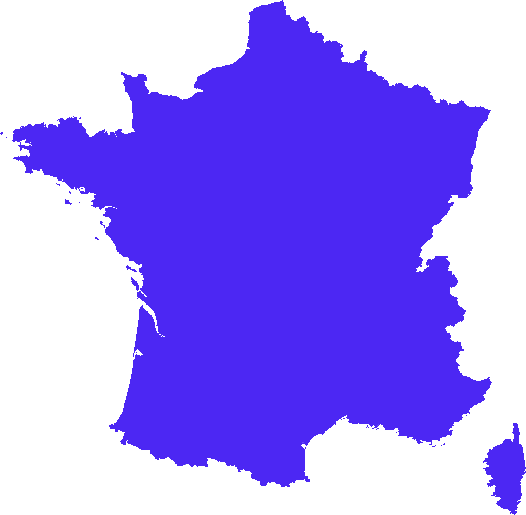
with western and southern linear borders. Its surface area is equal
to 184% that of France.
It borders Israel in the east, Sudan in the south and Libya in the
west. It confines to Israel and Jordan in the gulf of
Aqaba. It is bordered by the Mediterranean Sea in the north and the Red Sea in
the east.
The geography is presented in two sets of areas:
The river area: The Nile makes Egypt. The fertile alluvial
Nile valley and delta are 3% of the territory where 90% of the
population live primarily on farming.
(less than 6% France for +70 million Inhabitants!) This narrow band
deeply embanked between desert cliffs widens out to reach 10 to 15 km width.
The area of the delta stretches roughly from Alexandria to Port-Said.
The desert area: Egypt belongs to the desert belt of the
tropic of Cancer. In Africa, the Sahara stretches from the Atlantic to
the Red Sea. Two plateaux are constitutive, the Libyc
plateau in the west of the Nile and the Arabian one in the east with
the subsidence of the Red Sea. Beyond the Suez Canal, the Sinai peninsula
belongs to the Arabian plateau. Egypt is a desert to +95%.
The climate of Egypt depends on its geography:
The river area: The Nile floods have shaped the landscape of the valley
by its contributions in alluvium. The river is the only source of
humidity. Although Lake Nasser makes the climate of the area evolve, too.
The desert area: With 2mm rain a year, this area is
inhuman by its summer temperatures that can reach the 50°C.
Animal life has changed considerably:
The fauna of the Pharaoh time, represented by the monument paintings,
has become non-existent in the Egyptian landscape. Only migratory birds are
still in abundance at the time of the North-South migratory flow, Europe/South Africa. |
|
|
|
|
Located between the 32d and 22d parallels, on the southern
border, Egypt is a desert except for the Nile valley. The
geological fracture dug by the river floods is impressive by
the contrast of landscapes, arid deserts and green gardens in the
palm plantations.
The road between the river and the channel has made it
possible to understand the economy of the area for more than
five millennia. The channel is bordered by norias, driven by animal
force or by engine, pumping the irrigation water to the fields.
|
|
|
|
|
Economic facts |
|
Civilisation |
|
|
|
|
Egypt's economy has developed regularly since Nasser's policy
continued by his two successors.
Agriculture is 17% of the GDP with 29% of the working population.
The agricultural production increases by 2% a year. It produces sugar
and cotton (1st world producer). Irrigation works continued.
Mineral Resources: All ores are represented. But hydrocarbons
represent the most significant part of the production.
Industry: Nasser's revolution strongly developed heavy
industry. Since, it has been gradually privatized. The processing industry
develops regularly.
Trade is developing strongly and transforms the economy of the country.
Tourism, in spite of the Middle East troubles, brings money to Egypt.
The Egyptian currency is the Egyptian Pound. |
|
The official name is the Arab Republic of Egypt whose capital is Cairo.
The population is +70 million inhabitants.
The official language of Egypt is Arabic as well as English.
The population is made up of Berbers, Bedouins and Nubians.
Egypt is a democratic republic with several parties.
Egyptians are 94% Sunni Moslems, 6% Coptic Christians. Islam has the
same origin as Judaism and Christianity. The faithful of these
three religions belong to "people of the Book".
It is a trite to say that hospitality is the corner stone of Arab
culture. This tradition is the consequence of the hardness of the life
in the desert and the habits of Bedouin tribes of accommodating
stranger by offering them water, food and the lodging.
The GNP is US$3,600 per capita. |
|
|
|
|
Beyond dynastic and religious quarrels, wars and
crusades, arts and letters underwent an extraordinary rise
by the continual mixing of men from all horizons bringing thought
and technique.
But World War II, the Franco-British 1956 expedition, the political vaticinations
of Western States, the Near East troubles in 2003 are as many humiliations badly
accepted by the populations of the area.
|
|
|
|
|
traveller's information |
|
Sights |
|
|
|
|
All tourists need visas and six-month valid passports. The visa is
available at the consulates or in certain cases on arrival. Valid
one month, it can be extended.
On the health plan it is recommended to consult specialized websites, in
France the website of the Foreign Office. No particular precaution is
required, it is necessary to be up to date with one's usual vaccinations.
The traveller's budget depends on his choices, Egypt offers opportunities
for small budgets. |
|
The geographical situation of Egypt, its climatic variety
offer travellers multiple possibilities of activities in the
archaeological sites as well as on the coasts.
They offer all opportunities to sportsmen. Sports
activities are possible in all the areas of Egypt, golfing,
safaris, swimming, diving and snorkelling on the Mediterranean and Red Sea
coasts.
In spring 1989, a package tour was made in Egypt in connection with
Syria |
|
|
|
| Neuilly, le 2003/11/23 |
|
|
|
|
|
|