|
|
|
Burma
vs Myanmar |
 |
|
For the West
Burma is a military dictatorship which does not respect
humans rights. A large number of N.G.O's require
that tourists abstain from visiting it. Such is not my opinion,
it is quite out of question to exclude the Burmese people from
our consideration and to leave it aside from the evolution of the
world. By visiting Burma we force the Military Junta to take this fact in
consideration, thus the visa passed from 8 days in 1987 to 28 days
in 2003.
The history of this
country is closely related to that of its neighbours, the
Kingdom of Siam in the east and India in the west. It is outlined
concisely.
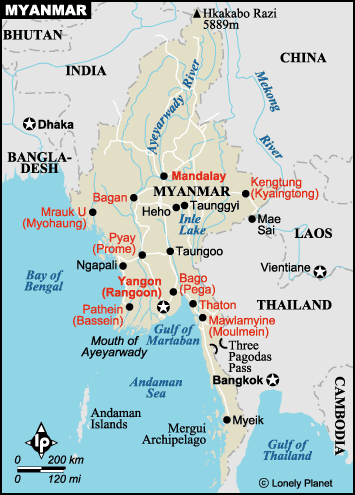
The geography is presented
in large maps to locate the journey.
Burma, Myanmar in Burmese and Burma
in English, is the land of the Burmese, Tibeto-Burmese,65% of
the population. |
|
|
|
|
|
History |
|
Geography |
|
|
|
|
The history of the
territory called Burma is attested as early as the first millennium BC
by archaeological excavations, the arrival of Môn from Kampuchea, Burmese
from the Himalayas, Thai from the north of Thailand.
The history of Burma is divided into six periods.
From the 11th to the 16th century, this period started with the creation of the
kingdom of Pagan on the present territory of Myanmar. In 1287 the
Mongolians invaded the area which they dominated until the end of
the 15th century.
From the 16th to the 18th century, the reunification of the area intervened with
the Kings of Taungoo. The break-up came from the claims of the
minorities.
At the beginning of the 18th century, the country was divided into a
Môn State and mountain Tribes. Border incidents involved interventions
of the British from India.
From 1824, the India British empire set up Pax
Britannica by managing the country directly. During World War
II the Japanese intervention had the same consequences as for the neighbours
in South-east Asia.
On 04/01/1948, Burma became independent and set a
Socialist and Buddhist Democracy .
On 02/03/1962, a Military Junta take power never to let it
even though it pretended to democratize the government by having the
people vote for a constitution. |
|
Burma is enclosed in a horseshoe of mountains slightly open onto the sea.
It stretches 2,100Km from north to south, 960Km at its widest and 2,800km
of coastline. However the penetration by the sea is difficult.
In the west, on the side of India and Bangladesh, the Chin chain spreads out covered
with dense forests. In the east, on the side of Thailand the Shan plateau
forms a natural border. In the north-east, on the side of China, the Kachin
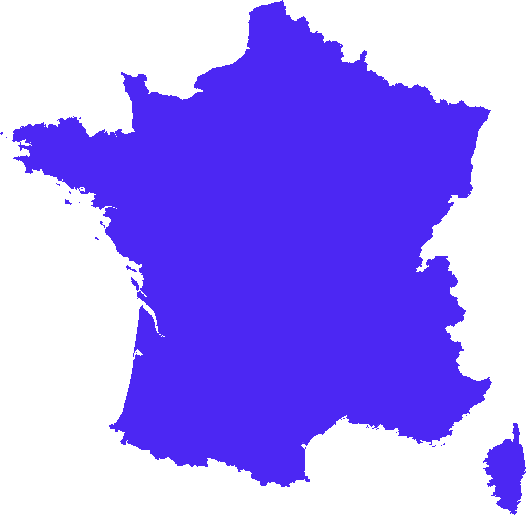
mountains reach altitudes of 6,000 m. The surface area equals that of France,
Benelux and Switzerland together.
It is divided into four great areas.
The Western part is the prolongation of the Himalayan fold with
the hills of Naga, Patkai, Chin, Arakan.
The central part is the depression of the three large rivers Irrawaddy,
Chindwin, Sittang. It is the heart of the Burmese country where the old
capitals were located.
The deltaic part consists of the delta plain of the three
rivers whose alluvia advance 60m per annum. It is the land of paddy
fields, "the rice bowl" of Burma.
The Eastern part is made up of the Kachin mountains
then Shan plateau in the north and of the peninsula by Tenasserim chain
in the south.
Monsoon is the climatic phenomenon which governs the pluviometric
system of the area. |
|
|
|
|
The Burmese landscape is made up of farms, paddy fields in the
large central depression and rustic agricultural tools, buffalo carts,
wooden swing-ploughs, sail needle of fishing in the lakes and
rivers, long lines of bicycles on the roads.
|
|
|
|
|
Economic facts |
|
Civilization |
|
|
|
|
Burma meets with difficulties to develop itself. The cover rate of the
imports is only 70%, the remainder comes from international assistance.
There is no famine in Burma.
Agriculture
occupies 63,5% of the working population. The exports of rice, jute,
cane sugar, teak provide nearly 65% of the Burma currencies.
Mines, the soil has iron and copper
layers. Energy, the presence of gas and oil make it possible to consider
self-sufficiency, due to the limited number of cars.
Industry occupies
11% of the working population for 16% of the national wealth,
especially the handicraft industry.
Services are
little developed except in the administrations. Tourism
could increase with the rise of visas.
The Burmese currency is the kyat. |
|
The official name is
Union of Myanmar whose capital is Yangon (Rangoon). The
population should be 50 million in the year 2000. The language of Burma
is Burmese, but there are also the Karen, Chin, Shan
and Kachin dialects.
The population is made
up of three ethnic groups, 87% of Tibeto-Burmese, as well as Môn-Khmers and
Sino-Thai.
In Asia the concept of
poverty line is unsuited, the GNP is $1,500 per capita.
Burma has been governed by a Military Council since 1962.
Then on 04/01/1974 a constitution founded the Burmese way towards socialism.
The Congress of the People elected by universal franchise is the supreme
authority. The Socialist Republic of the Burmese Union is composed of
seven Burmese Divisions and seven States.
The Burmese are 87% Buddhists, 5% Catholics, 4% Moslems, 3% animists. |
|
|
|
|
Burma attracts tourists either for cultural activities by visiting
the monuments or for sports activities. Tourists are impressed by the
fervour of the Buddhist population and the omnipresence of monks in saffron robes.
|
|
|
|
|
Traveller's information |
|
Sights |
|
|
|
|
A 28-day
visa is necessary to enter Burma. It is not renewable.
The vastness of the country, the diversity of the climates,
the selected season are as many parameters to be taken to define the conditions
of holiday.
On the health plan it is recommended to consult specialized
websites, in France the website of the Ministry of Foreign Affairs.
Thailand offers opportunities for small budgets. |
|
Burma is also an
ethnic mosaic and three groups of languages, rebellions minorities in
the mountains who deserve to be met.
Each area has its
personality, and its centres of interests. Several journeys will be
necessary to appreciate this cultural diversity.
Sports activities are possible in all parts Burma, excursions, diving,
cycling tours.
The journey was made in 1987, a package tour associated
with the individual journey to
Thailand.
|
|
|
|
| Neuilly, le 2003/09/07 |
|
|
|
|
|
|